• Skip to primary navigation
  • Skip to main content

SCP Survival

Best Survival Gear and Supplies

  • Download Survival Guides
  • Survival Food List
  • Download 906 Survival Guides to Your Device
Home / Survival Food / Page 7

Survival Food

How To Grow Black Cap Raspberries (Easy DIY)

March 20, 2024 by Seasoned Citizen Prepper

Blackcap Berries

When I was a little girl, a yearly ritual was when my Mother took us all out to hunt for blackcaps. Blackcaps are those delicious little wild raspberries that pop up everywhere.

Blackcaps like sun and usually grow on the edge of the woods. Horses and cattle eat berry plants, so they usually aren’t in the pasture.

We always took the dogs because it could be dangerous if you ran into rattlesnakes – which it seemed we always did. The dogs would usually spot them before we got near and a few barks would chase them off. But if you found a nice patch and got separated from Mom and the dogs, well, you better look down.

I’ve had ever-bearing raspberries for many years. I even dug up some of my plants when I was forced to move over here. And there is a little patch of blackcaps on a wayward part of this property.

Blackcaps and raspberries don’t mix, so when you’re making your layout, remember that you’ll need to keep them at least 300′ apart. That said, you will probably get them in your raspberry patch anyway, because the birds like to eat both and will transplant the blackcap seeds to your raspberry patch.

I am a lazy gardener; there is always lots to do on a homestead. On my homestead I planted them in an out of the way spot with sun, harvested the berries throughout the season (usually one large crop in late June and sporadically thereafter) and then just mowed them down in the fall.

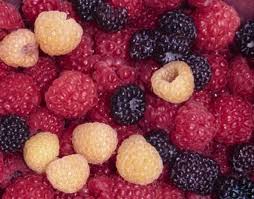
Raspberries come in different colors!

The lady who had this place before me had raspberries too, but she got old and the grandkids just mowed over her whole garden every year trying to kill them and everything else. Well, I planted mine along her fence line and also planted hers that I could salvage.

Now I have a fence line of raspberries that I have to mess with – but this place is way smaller and I have more time now. But somehow time seems to be going faster – or I am going slower. The thought behind putting them by is fence is that you can tie them up and put bird netting over them if desired. I have found that to be too much work.

Raspberries are technically biennials. However, everbearing raspberries are a bit different.

Everbearers fruit twice on the same cane. These canes will fruit at the tip during the fall and then bear again the following spring farther down the canes. If one large crop is desired, cut the canes back to the ground after the fall crop. This will result in a single, large crop the following fall.

Not what I have found to be true with my berries, but what the experts say.

This year in Minnesota we seemed to have gone from winter to summer in 2 weeks! So into the raspberry patch I go.

How To Prune Raspberries

They are just beginning to leaf out and many haven’t yet, but I wanted to get some of the young ones back in line so that I don’t run over them with my garden tractor.

So here is the down and dirty of raspberries:

  • They spread on runners. With a bad winter they will often not leaf out totally, but come back from the root stock like many roses did this year.
  • Move the babies back in line and cut out the old dead canes.
  • Watering in good and mulching will really help your survival rate.
  • Don’t get the bright idea (I tried already and it didn’t work.) to lay plastic down in the aisle to keep the berries in place. You’ll just lose your babies and have a much thinner patch of berries.
  • You can tell blackcaps from raspberries as they grow. Blackcaps will have more arching canes that will touch the ground, root and make more blackcaps. The canes are also slightly reddish compared to the everbearing canes. PULL THEM OUT!

Mine have already started to blossom in this heat. It only takes 4-6 weeks from blossoming to the first berries.

Filed Under: Gardening

Can You Overwinter Parsnips?

March 20, 2024 by Seasoned Citizen Prepper

On April 17th just north of the Twin Cities there was 15 inches of snow. To refuse to get down about continuing snow I decided to bring in the first harvest of the year. Parsnips!

Parsnips Very early last spring I got that heavenly nudge to learn to grow parsnips. I had never even eaten parsnips much less grow them, but I know the nudge so I began to research.

At one of the early farmers markets in late April when there was hardly lettuce, yet there there was a farmer and his wife with parsnips.

I asked him if he was from around here, because I thought parsnips were harvested in the fall best after a frost. He said that they were good then but if you leave them in the ground and they go through the long hard winter they are even sweeter harvested in early spring. I felt the nudge again that many of us are like that too having gone through long hard winters of life and come out better the other side.

I grew parsnips and they are wonderful. I left some in the ground to test the word on overwintering. If they could make it through this winter we have had they could make it through any winter. I did not cover or mulch them at all.

Roasted Parsnip fries I decided today as it was snowing a little here to harvest some and it is true. They were great roasted for lunch.

If you can grow them in your climate just think, early spring and the fresh potatoes and squash stores are eaten and no crops ready, yet but you can go dig fresh parsnips.

What an amazing provision!

Filed Under: Gardening

7 Quick Tips for Storing Spices and Herbs

March 20, 2024 by Seasoned Citizen Prepper

Many of you have read by now my experience with VacuCraft canisters.

I did want to share another little “thing” I do to try and keep my spices, herbs & other foods as fresh as I can whether it’s for dry pantry storage or in my refrigerator since I just finished jarring up about 7 jars.

  1. I determine which size of jar I’ll be needing to hold the food.
  2. I grab one of my “used” canning lids (I do NOT throw them away!) and a ring.
  3. Using my canning funnel, I put the herb, the spice, or the food, into the jar.
  4. I use a small “awl” and puncture a tiny hole in the lid.
  5. I cut a small piece of black electrical tape (about ¾ inch long) and place it over the hole.
  6. I then use my manual hand pump (either one of those that came with my VacuCraft or one of those that I’ve purchased with the Ziplock system).
  7. Place it over the taped up hole and vacuum until it’s very hard to pull your pump up. At this time, your lid should be sealed.
  8. Put the ring on it, and put it where you want to store it.

I use this same method when I’ve opened olive jars, pickle jars, and various other jars… just puncture a hole in the lid, tape it, vacuum it and put it back in your refrigerator!

I hate throwing out foods!

Filed Under: Survival Food

What Are the “Three Sisters?” [plus how to plant them]

March 20, 2024 by Seasoned Citizen Prepper

Three Sisters gardening — corn, beans, and squash planted together using Native American companion planting method

If you have a small garden plot and don’t like digging it up every year, Three Sisters gardening may be for you. It’s a Native American companion planting technique at least 1,000 years old — practiced by the Haudenosaunee (Iroquois) Confederacy, the Pueblo peoples of the Southwest, and Mesoamerican milpa farmers across what is now Mexico and Central America. They grew these three crops together not for tradition’s sake but because it works: the combination produces genuinely higher yields than any of the three plants grown alone.

It adapts to climate conditions, requires minimal year-to-year soil disturbance, and produces calorie-dense crops you can store. For a survival garden or homestead, it’s one of the most efficient things you can plant.

So, What Are The 3 Sisters?

The Three Sisters are corn, beans, and vined squash. Each one solves a specific problem for the others:

  • Corn grows tall and straight, providing a natural trellis for the beans to climb — no stakes or cages needed. It’s a heavy feeder and susceptible to wind, both of which the beans help address.
  • Pole beans fix nitrogen from the air into the soil through bacterial activity in their root nodules, feeding the corn and squash. Their flowers attract pollinating insects. Their vines bind the corn stalks together for wind resistance.
  • Squash spreads across the ground as a living mulch — shading out weeds, retaining soil moisture, and deterring deer and raccoons from the corn with its prickly leaves and vines.
Three Sisters garden diagram showing placement of corn, beans, and squash in mounds

Check out the layout depicting the placement of corn, beans, and squash.

Mound, Flat, or Depression — Match Your Climate

In wet or cold climates, mound your planting area. Corn hills about 5 inches high and 18 inches across allow the soil to warm more quickly in spring and improve drainage. You can plant earlier this way, which matters in a short growing season. In dry climates, dig a slight depression instead — it channels water toward the roots and retains moisture that would otherwise evaporate. If you’re getting the normal 40 inches of rain most vegetables want, a flat circle works fine.

Choosing Your Varieties

Variety selection matters more than most Three Sisters guides admit. The wrong choices and the system doesn’t work — the corn gets overwhelmed by the beans, or the squash clumps rather than spreads.

Corn: Three Sisters gardening often works best with flint, dent, or flour corn varieties, as they are harvested at the end of the season. Native American varieties like Hickory Cane Dent Corn and Cherokee White Flour work well. Sweet corn can be used but requires you to carefully navigate sprawling squash vines at harvest. Avoid very tall, weak-stalked hybrid varieties that may fall over once beans start climbing.

Beans: They must be pole beans (vine-type), as modern bush beans are incapable of climbing cornstalks. Good pole bean choices include Blue Lake, Scarlet Runner, and Italian Snap. Kentucky Wonder — which we grow and review here — is one of the most reliable heirloom options for this system.

Squash: Use a winter squash variety — butternut, acorn, delicata, and the like — which grow on vines that spread across the ground. Summer squash varieties like crookneck and pattypan won’t work because they grow in single clumps rather than as a spreading groundcover. The trailing vines are what make the living-mulch system function.

Corn — Planting and Growing

Corn is wind-pollinated and needs other corn in close proximity for best results — no pollination means no kernels. This is why you never plant corn in a single row, and why the circular or clustered mound system works so well: plant corn first after the last frost, when soil temperatures reach at least 55°F. Plant 4 corn seeds in a square pattern at the center of each mound, then thin to the strongest 3 seedlings after germination. By planting in a tight cluster you get optimum cross-pollination between plants.

Pole Beans — Structure and Nitrogen

If you’ve ever planted pole beans you know they will take over any structure they can find. That’s the feature, not the bug. When corn reaches 4 to 6 inches tall, plant 4 pole bean seeds around each corn stalk — one bean at each of the 4 compass points, 6 inches from the corn. The vines will bind the corn stalks together, providing maximum wind resistance. The flowers attract pollinators that benefit the whole garden.

One thing worth doing: coat the bean seeds with an inoculant before planting for better nitrogen fixation. Inoculant is a powder containing the right bacteria for legume nitrogen fixation — inexpensive, widely available, and makes a real difference in soil enrichment, especially in new garden beds.

Squash — Moisture, Mulch, and Deterrence

When the beans reach six inches, plant squash seeds around the perimeter of the mound, spacing them 18 inches apart. The spreading leaves retain moisture in the ground, stunt weed growth by shading the area, and attract additional pollinating insects. The prickly texture of squash leaves and vines also deters deer and raccoons — they don’t like navigating through it to reach the corn.

Three Sisters garden watering pot sunk in center with corn planted around it

Here’s a setup that works well: sink a garden pot in the center of your mound for deep watering. Plant six corn around that pot. Add the beans on the outside of the corn a week later, and four squash plants a week after that. The sunken pot directs water straight to the root zone — efficient, especially in dry stretches.

Getting Going — Planting Schedule

The staggered timing is critical. Plant everything at once and the corn gets overwhelmed before it can establish:

  1. Corn first — after last frost, soil at 55°F minimum
  2. Beans about a week later — once corn is 4–6 inches tall and growing confidently
  3. Squash a week after that — when beans are reaching 6 inches

Want to extend your harvest across the season? Sow seeds any time after spring night temperatures are in the 50-degree range, up through June. Plant successive mounds a week or two apart and you’ll have Three Sisters dining for as long as your growing season holds. Depending on how you like to put up vegetables, you can spread the work across the summer or batch it all at the end into a big canning session.

One more maintenance note: do not apply nitrogen fertilizer once beans are established — the bacterial fixation in the bean roots supplies what the corn needs. Adding nitrogen at that point throws the system off balance.

Storing Your Harvest

Squash stores particularly well. A dry, cool area — root cellar, basement shelf, spare bedroom — keeps most winter squash in good eating condition for three to six months without any processing. Butternut and acorn are the most forgiving. Check them monthly and use any that start to soften first.

Dried beans from this system are among the most storage-friendly calories you can grow yourself — sealed in Mylar with oxygen absorbers, they last 20+ years. Corn can be dried and ground into meal, or pressure-canned as whole kernel. The Three Sisters aren’t just a companion planting system — they’re a complete calorie-crop strategy. For more on maximizing what your garden produces for long-term storage, see our calorie crops and gardening for survival guides.

Don’t overthink this one. Just have fun and enjoy some sweet, all-American calorie crops.

Filed Under: Gardening

No Knead Artisan Bread [Recipe]

March 20, 2024 by Seasoned Citizen Prepper

I’m betting on a lot of you on SCP are bread makers. So I thought I’d share my absolutely MOST favorite bread that I make up. I use the basic recipe of the YouTuber called artisanbreadwithsteve… if you’d like to find him.

I’ve used it for several different types of breads, but I don’t have one of his fancy ceramic crockpots, so I use either my Corningware crock with it’s lid, my small cast iron skillet (if I’m camping), my mini-bread loaf pans, my regular sized loaf pans or my larger sized loaf pans.

This recipe works almost flawlessly… unless you alter the type of flour you use. I’d suggest getting used to the “basic” recipe before you step into the designer-type breads.

Either way, I’m just sure you’ll love it as much as I do. One of the main reasons I love it is that I put the dough together in about 5 minutes or less, follow his directions of covering it with plastic wrap & forgetting about it for 8-12 hours. You let your yeast do the work for you. I usually put it together after supper and then get it ready for the 2nd rise just before I start breakfast.

Cleanup is a breeze. Just a bit ago though (before lunch) I mixed up a batch of dough because I planned to make some hoagie buns for our sandwiches etc. I love being able to take the same dough, make a few minor adjustments (raisins, cinnamon, sugar or ground flax, ground sesame seeds, oatmeal, you name it!) and having scruuumptous and easy artisan breads… be they round, square, oblong or whatever shape I want them to be in, even braided!)

You Will Need:

  • 3 cups sifted flour
  • 1 ½ tsp. salt
  • ¼ tsp. instant yeast
  • 12 oz. room temp. water

Directions:

  1. In a glass bowl, mix all dry ingredients with a wisk. Add water & use the HANDLE of a wooden spoon or plastic spoon.
  2. Starting at the outer edge of  your bowl, work your way inward until the dough begins to pull away from the bowl (It will be a somewhat “sticky” bowl)
  3. Cover with plastic wrap & set in a safe place and leave for 8 to 12 hours to rise (about double).
  4. When risen, set your oven to 450.
  5. Grab you favorite 8″ skillet (I like my cast iron one) and oil it GENEROUSLY.
  6. Gently push your dough out of the bowl onto a floured surface.
  7. Flour your hands and gently flatten your dough to about 2 or 3 inches and then FOLD gently the ends inward, then the sides inward.
  8. Place the dough in your oiled skillet & then turn it over to make sure both sides are oiled.
  9. Place in your pre-heated, 450 oven, and bake for 30-35 minutes (until golden brown).
  10. If you “tap” on the top of your bread, it should “thump” and this should mean it’s done.
  11. Remove it from your skillet, let cool on a rack, and when thoroughly cool, place in a bread bag.

(DO NOT KNEAD THIS DOUGH!!!!)

Filed Under: Recipes

Food Storage: Here’s What Works For Us

March 20, 2024 by Seasoned Citizen Prepper

I try to not be afraid to admit that I need to try new things or different ways of doing things when a particular tactic is showing less than stellar results. To that end, our food storage has evolved over the years into a loose plan that, hopefully, will meet our needs and the needs of our family and close friends should it be necessary.

In the last years of the last century, Y2K was on everyone’s minds. For those with a ‘prepping’ mentality, Y2K gave us an opportunity to get our feet wet in what, for many, became a lifestyle of choice. It served to awaken within me that desire to be as pro-active, as prepared as I could be in every way.

Like some of you, before we had a really solid survival food list, we made purchases of buckets of wheat, soy, popcorn, rice, beans, you name it. Most of it suited our lifestyle. Some of it didn’t. I’ve mentioned before that soy doesn’t suit my palate, but on a homestead very little goes to waste. Chickens will eat nearly anything.

But it’s hard to eat 5 gallons of popcorn because after a few years, it just won’t pop. The wheat we did well with, since we grind our own for bread and wheat lasts almost forever. We finished up the last of the Y2K hard red wheat in 2013 and couldn’t tell that it was the worse for sitting in a five gallon bucket for 14 years without any special treatment. We had originally nitrogen packed it in the buckets ourselves, but once opened, it was exposed to ordinary air.

We had virtually no problems with bugs in wheat, barley or rice and bugs don’t seem to like pinto beans, but they get a bit hard to cook after a while.

I’m the prepper in the family and feel like I have to be prepared for this family of 19 people, 42 chickens and 3 cocker spaniels.

We actually eat from our preps. Our day to day pantry and prepping pantry are one and the same so we have overcome the issue of having stored food that is cheap and easy to keep, but not on your everyday menu. We have no freeze dried, no MREs, Mountain House meals or dehydrated strawberries.

We do have several cases of strawberry jam, purchased in 2010 at a very good sale price. I opened another jar this week and it is as good as when I bought it. Last year several local supermarkets had sales of name brand canned vegetables, products that we normally use, at 2 cans for $1.00. Too good to pass up and so we have perhaps 3 dozen cases of corn, green beans, whole and sliced potatoes and carrots.

Another time we got Wolf Brand chili without beans for $0.59 and laid in at least a 5 year supply. My daughter refuses to serve her family from a can or a box with an expired date, but properly canned foods have been found to maintain their nutrition for years longer than we’ve been led to believe, and my personal experience bears that out.

What we have stopped doing is buying our beans of various kinds, wheat, barley, corn meal, rice and several additional items either in large bags from supermarkets or in 5 gallon pails from the suppliers we all know so well. While those are economical ways to prepare, we have decided that, for the two of us, those are quantities that are likely to deteriorate to some degree before we can use the entire large bag or 5 gallon pail. We still have some beans and wheat in 5 gallon pails, unopened, so they’ll last until we need them, and if a disaster ever happens and we have to feed more than the 2 of us they’ll come in handy.

The major change in our method has been to purchase what is available in #10 cans and we are storing and using from these cans for the above mentioned items, as well as pasta, rolled oats, noodles and granola. I know that the cost to purchase in this size containers is a bit more expensive, especially compared to buying your pinto beans at Walmart, but we take comfort in knowing that the things we need are here and will last indefinitely and that comfort and security is part of what you pay for.

Our diet is supplemented extensively with the regular canned vegetables in our stockpile, as well as canned hams, salmon, chicken, tuna and some other meat products for protein. Again, all a part of our everyday diet. And, all things considered, since I purchase most of our supermarket food ONLY when it is on sale, my overall cost, even when purchasing rice in a #10 can, is lower.

We are on sort of a paleo diet, and we’re not big consumers of wheat, especially, and use almost no processed products, most of which are not packaged for long term storage. Our meals also rely heavily on our garden during our long growing season. We end up eating most of what we grow and share with friends and family so we don’t do a lot of canning or freezing.

So, the rest of the story? Finally, after 30 years of prepping, the last 20 of which have been ‘serious’ prepping, we’ve all but eliminated the waste from our food storage. The advantage I feel we enjoy is switching to #10 cans for the mainstays, and buying in bulk at the local supermarket when they have a crazy sale (and don’t worry too much about those expiration dates).

Filed Under: Survival Food

  • « Go to Previous Page
  • Page 1
  • Interim pages omitted …
  • Page 5
  • Page 6
  • Page 7
  • Page 8
  • Page 9
  • Interim pages omitted …
  • Page 14
  • Go to Next Page »

Copyright © 2026 · Genesis Sample on Genesis Framework · WordPress · Log in

  • Privacy Policy