• Skip to primary navigation
  • Skip to main content

SCP Survival

Best Survival Gear and Supplies

  • Survival PDFs
  • Survival Food List
  • Download 906 Survival Guides to Your Device

How To Can Meat (Beef, Chicken, and Fish)

March 8, 2024 by Seasoned Citizen Prepper

Just when you thought it was safe to put those canners away…no, indeed! Canning is not a “season”. Look for sales on your favorite meats, and don’t worry about freezer space or power out situations.

Let’s get canning!

Remember: ANY FOOD THAT CONTAINS ANY AMOUNT OF MEAT MUST BE PROCESSED AS MEAT, REGARDLESS HOW MUCH OF ANYTHING ELSE IT CONTAINS.

It is possible, of course, to cold pack meats, but I do not recommend it and do not practice such. It is important, IMHO, that meat be at least partially cooked because you don’t want some of that “gunk” that will cook out of meat in your canned food products; you want them ready to eat. This “gunk” also frequently gets under the cap while processing and prevents a seal. It’s also safer practice to hot pack meat than it is to raw pack meat, so, let’s practice “safe canning”!

I use a dial gauge pressure canner. The other type is a weighted gauge. All canning instructions are given using metal caps and rings, not Tattlers.

Even pre-cooked meat will expand while processing. Keep that in mind when packing jars.

When using commercial products, watch for MSG (Monosodium Glutamate) in these mixes  and broths folks – they’ve love to put ‘em there! I use only brands that do not add MSG. You do not want neurotoxic food, not now and certainly not post-IHTF!

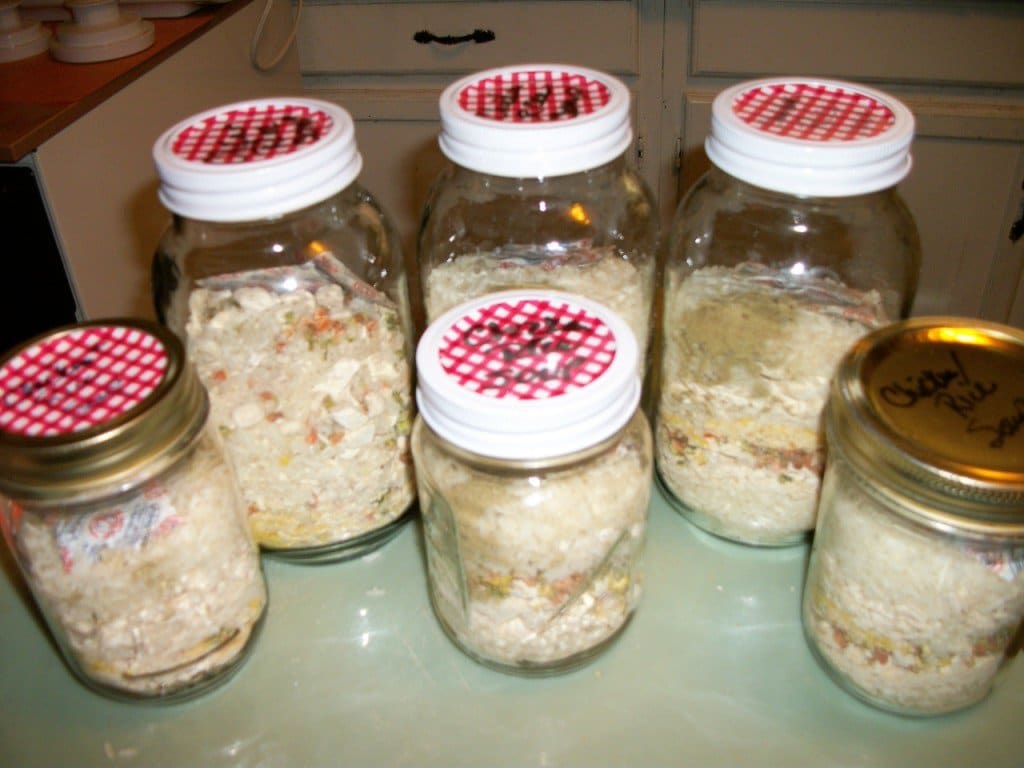
How about some ready to eat chicken or chicken soup? My idea of fast food!

There are two or three ways I like to can chicken. You will do it your way, as you should, based on what you like, but here’s how I do it.

Chicken Soup

For soup, allow one large or two small chicken breasts (about one pound meat) per quart, half of that per pint.

You can never have too much home-made chicken soup on hand. Sometimes, it just tastes good; but when you or someone you love is sick, this is just what you need to give the healing process a helping hand.

We like mostly just white meat, so I usually buy breasts on sale and remove the skins and excess fat.

Here’s how I can it:

  1. While you’re prepping meat, CHECK YOUR JARS – run a finger lightly around the lip, making sure there are no “fleabites” or damage.
  2. Then, put jars in dishwasher (if you have one) and wash; keep in dishwasher to keep hot. Or, wash by hand in hot, soapy water, rinse in hot water, and keep on cookie trays in 250 deg. F (121 deg. C) oven to keep jars hot and clean until ready to pack. Always prepare at least two extra jars – “stuff happens”!
  3. OK, so, I’ve removed all the skin from my chicken, trimmed any excess fat, and placed it all in a big, deep pot.
  4. Now I add my “Cajun Trinity” – chopped celery, onion, and garlic galore! Never too much garlic! It’s very healing – a super food, “anti-inflammatory”. Also chopped carrots (2 large will do – or several small ones) and 3 large bay leaves.  Iodized sea salt (iodine is an important nutrient to the human body, and we are losing it) and cracked pepper to taste. Cover with good clean, water, and bring to a boil.
  5. When chicken starts boiling, turn heat down to medium and cook, covered, until chicken is tender – at least an hour for a pot this large.
  6. Remove lid; allow chicken to cool a bit. Remove bay leaves before packing jars.
  7. Remove meat from broth; allow meat to cool and hand-pick bones.
  8. If you have pets, cook (you can pressure cook them) those picked out chicken bones until they are super soft; allow to cool; grind up or mash (they’ve very soft by now) and feed to pets. It is an excellent source of calcium to strengthen their bones, but, never, ever give just the chicken bones to a pet – they will splinter in their intestines and cause serious health problems, leading to surgery or death. People can eat this, too, BTW, as a ground form, only (for the same reasons).
  9. Strain liquid to remove “gunky stuff”. Use this liquid for hot packing after filling jars with meat but always have extra broth standing by, just in case.
  10. Break, tear or cut meat into bite-size pieces and drop back in hot liquid.
  11. Have a medium pot of water boiling at this point for caps and rings.
  12. Start heating water in pressure canner, but keep heat on low for now.
  13. Hot pack in pint or quart jars. Wipe lids twice: the first time with a piece of fresh, clean paper towel dipped in hot water (kitchen gloves recommended!); the second time with clean paper towel and white vinegar (to remove any lurking fat residue).
  14. Boil caps 30 seconds and place; boil rings 30 seconds and place. Boiling much longer may result in loosening or boiling off of rubber liner to caps, no matter what you see on blog sites, and now they will not seal.
  15. Tighten lids, then check to make sure they aren’t too tight (a common cause of losing liquid in processing jars).
  16. Place hot jars down inside hot water of pressure canner, but remember, temps can’t vary too much (temp of jars and water in canner), else you’ll get thermal shock breakage.
  17. Put lid on canner; on medium heat, cook until the steam spews out of vent pipe; as soon as it starts to spew out at a noticeable rate, time for ten (10) minutes; this is the important  “10 minute tornado”. This will remove excess air from pressure canner, allowing it to reach and maintain proper internal temp for safe food canning. If you are using a weighted gauge (such as a Mirro with only 5/10/15 lb. increments), this is not necessary, as it will vent out while cooking. It is ALWAYS necessary with a dial gauge.
  18. After 10 minutes, place your weight on vent pipe. Bring to temp over medium to medium-high heat (I don’t know your stove or how hot it cooks) and hold it there; start timing as soon as it reaches proper pressure. If at any time it drops below the required pressure, bring it back by turning up heat just slightly, and start timing again. Just watch it so it doesn’t have opportunity to drop below temp for very long. You don’t want food cooked to mush. If you get too much pressure, GENTLY release a little using the weight (move it slightly to release pressure) until it reads correctly. Do not get in a hurry in releasing pressure – this can result in extreme temp fluctuations, which forces liquids out of jars.
  19. Process jars 10 lbs. pressure 75 minutes for pints, 90 minutes for quarts, if under 1000 ft. altitude; over, add 2 lbs. pressure to 2000 ft; over that, add 2 more lbs. pressure (14 lbs.) and use same processing times for pints/quarts.
  20. Allow canner to cool on its own (pressure drops to zero on gauge). Remove lid. Wait 5 minutes. Using jar lift tool, remove jars and place on baking racks with towels underneath to cool. When completely cooled (at least 2 hours) test lids for seal (tap outer edges of metal for sound). If any do not seal, refrigerate and use within 7-10 days, or reprocess, cleaning mouth of jar thoroughly and using a NEW boiled metal cap.
  21. When jars are cooled, remove rings, wash in hot, soapy water and rinse in hot water. Return to racks to air dry, but I like to dry top of caps off with paper toweling to prevent water rings on cap. When dry, mark contents and date, replace rings (optional, but I do it) and store away.

Give yourself a “Well done!”

DO NOT add any kind of starch (noodles, rice, etc.) until you are ready to serve. Cook starches –  noodles, rice etc. separately, while you are heating up soup; add pre-cooked starch food (while still hot) to heated soup and simmer together on low heat 10 minutes; then serve. Starch (noodles, rice, etc.) will turn to paste in processing!

Roasted Chicken

Canned, roasted chicken has a better flavor than merely “boiled” and is more versatile or recipes.

Allow about three (3) large chicken breasts per quart jar; half of that for pints.

I have an 18 quart Nesco Roaster/Oven. I like to use it because you can cook a large amount of food in it at one time and it does not use as much “fossil fuel” as some other methods of cooking.

I have discovered that I can roast up to 40 lbs. of chicken breast at one time, stacked in two layers, in this roaster; I just have to remember to put a wire rack between the layers; the rack actually lays directly on the bottom layer, but it still does the job.

Set roaster to 350 deg. F (moderate temp). If I did the math correctly, that should equal 177 deg. Celsius (350 – 32 = 318 x 5 = 1590 divided by 9 = 176.66 (177) C – for our international readers.

If you don’t have one of these Nesco roasters, just use your oven.

  1. Put a small amount of water in bottom of roaster. Put bottom rack in place (must use the rack to prevent meat from cooking to bottom of roaster); remove all skins and place first layer of chicken.
  2. Season meat to taste. I like to combine granulated roasted garlic with iodized sea salt and a bit of fresh cracked peppercorn mélange (combined colors of peppercorns), and just a bit of paprika.
  3. Place middle rack on top of this layer of chicken, and place second layer of chicken breasts, skins removed, of course. Season this layer of meat, also.
  4. Place lid. If you have two holes on top (I do), I like to plug them. I use two aluminum baking potato stakes, one dropped into each; they don’t seal completely, but, close enough; I do not want liquids evaporating from cooker.
  5. I will cook these breasts until tender, about 2 hours, depending on size of chicken pieces, how packed the cooker is, etc.
  6. While you’re prepping meat, put jars in dishwasher (if you have one) and wash; keep in dishwasher to keep hot. Or, wash by hand in hot, soapy water, rinse in hot water, and keep on cookie trays in 250 deg. F (121 deg. C) oven to keep jars hot and clean until ready to pack.
  7. Allow meat to cool; strain liquid; add more water, as needed, and use this wonderful, seasoned broth to pack your chicken. Also have prepared chicken broth standing by, in case you don’t have enough from roaster.
  8. Heat water in medium saucepan for boiling caps and rings; start heat under pressure canner, but keep heat low for now.
  9. Pack meat into hot jars, leaving 1 plus 1/2 inch (1 1/2 inch)  MINIMUM head space. I know – most books and sites tell you one inch. Even pre-cooked meat will expand while processing. Trust me. Allow 1 plus 1/2 inch or better for ALL meats.
  10. Now add broth to just over top of meat (one-half inch). You should NOW have one inch headspace from the top of the broth to the top rim of the canning jar.
  11. Clean the rims of your jars twice: first with hot water, then with white vinegar and a piece of clean paper towel for each swipe – you do not want to transfer fat or meat bits, and, using the same towel for all jars could do this.
  12. Place your boiled caps (30 second boil). Place your boiled rings. Tighten rings and then loosen a bit, if too tight. Remember: lids screwed too tightly are a common cause of loss of liquid in canning. But you don’t want them too loose, either.
  13. Place hot jars in hot water, but watch that temps are not too far apart: thermal shock breakage issue.
  14. Put lid on canner; on medium heat, cook until the steam spews out of vent pipe; as soon as it starts to spew out at a noticeable rate, time for ten (10) minutes; this is the important  “10 minute tornado”. This will remove excess air from pressure canner, allowing it to reach and maintain proper internal temp for safe food canning. FAILURE TO TAKE THIS STEP CAN LEAD TO IMPROPERLY CANNED FOOD. If you are using a weighted gauge (such as a Mirro with 5/10/15 lb. increments), this is not necessary, as it will vent out while cooking. It is ALWAYS necessary with a dial gauge, no matter what you are canning.
  15. After 10 minutes, place your weight on vent pipe. Bring to temp over medium to medium-high heat (I don’t know your stove or how hot it cooks) and hold it there; start timing as soon as it reaches proper pressure. If at any time it drops below the required pressure, bring it back by turning up heat just slightly, and start timing again. Just watch it so it doesn’t have opportunity to drop below temp for very long. You don’t want food cooked to mush. If you get too much pressure, GENTLY release a little using the weight (move it slightly to release pressure) until it reads correctly. Do not get in a hurry in releasing pressure – this can result in extreme temp fluctuations, which forces liquids out of jars.
  16. If pints, process at 10 lbs. pressure 75 minutes if under 1000 ft. altitude.  If over 1000 ft. altitude, process @ 12 lbs. pressure for 75 minutes for PINTS. If QUARTS, process at 10 lbs. for 90 minutes below 1000 ft; 12 lbs. for 90 minutes above. Over 2000, add 2 more lbs. pressure, same timing.
  17. ALWAYS allow your pressure canner to drop back to “zero” on its own. Don’t try to force it. When completely cooled (gauge reads zero), open canner; wait 5 minutes before removing jars (that water is still very, very hot and you don’t want to disturb jars just yet).
  18. After 5 minutes, remove jars from canner, allow jars to cool thoroughly.
  19. Check for seal when cooled (at least 2 hours in most environments).
  20. Remove metal rings when cool; wash jars and rings in hot, soapy water and rinse thoroughly in hot water. Return to racks and let air dry completely – several hours or even overnight. Replace metal rings. I like to wipe lids dry with paper towel after washing, rinsing, and returning to cooling racks – this prevents water rings from forming on caps, which makes it harder to write on them.
  21. Write contents and date on top of metal lids. Pack and store. Give yourself a “Well done!”.

Roasted chicken is highly versatile and you can do many things with it! My boys love “Chicken Enchilada Casserole”, which I have posted under recipes, over at the Forum.

Beef

There’s just not much better than popping open a jar of sliced, seasoned sirloin tip and turning it into a quick Po’Boy, or Manhattan, or whatever you like…and chuck roast, ground beef,  or roast beef have so many uses, where to start?!

Do have extra beef broth standing by, in case you don’t make enough for all jars in the cooking process.

Sirloin Tip Roast

For sirloin tip roast, I simply roast it as always, so it is “ready to eat”. I prefer to slow roast, and very often use my big Nesco roaster, as it uses a lot less energy and doesn’t heat up the kitchen as much as my big oven.

Once it is roasted to suit me, I simply slice it, pack it to 1and 1/2 (1 1/2) inches headspace, add liquid/gravy to cover, leaving one inch headspace, clean jar lips thoroughly, cap and process.

I use the liquid created in cooking, which I filter, then add my favorite ready-to-use gravy mix and water. You don’t even need to cook the gravy mix addition – just add it to jars; it will cook and thicken during processing, after which it’s just “heat and eat”!!

I usually buy a 10-12 roast, serve a meal with it, and can the leftovers; I usually get about 5 quarts leftover.

Watch for MSG (Monosodium Glutamate) in these mixes and broths folks – they’ve love to put ‘em there! I use only brands that do not add MSG.

Ground Beef

  1. Allow about 2 pounds raw ground beef per quart; 1 pound per pint (m/l). I always pre-cook ground beef; if you tried to pack this raw and then process it, you would have one big clump and would have trouble getting it out of the jar, I do believe.
  2. Brown your ground chuck in a skillet and drain fat off.  Some people can ground beef with no liquid; I prefer to pack mine in beef broth; this broth can be used later as a gravy base or saved for another project, or just cooked down, as in taco meat. I personally do not like dry meat, so, I use the wet-pack method.
  3. Process like any other beef.

Chuck roast

  1. Allow about 2.5 pounds raw chuck per quart, about half that per pint. I like to cut it up into bite-size pieces, cover with water, bring to boil. Cook JUST until it is just browned throughout – no pink left in the meat. It will finish cooking during processing.
  2. While you’re prepping meat, put jars in dishwasher (if you have one) and wash; keep in dishwasher to keep hot. Or, wash by hand in hot, soapy water, rinse in hot water, and keep on cookie trays in 250 deg. F (121 deg. C) oven to keep jars hot and clean until ready to pack.
  3. Skim that gunky mess of the top – DO NOT can without removing this first. This stuff will get in between the rim and the cap and prevent seal on many of your jars – trust me when I tell you this. Strain broth before packing. Besides, you’ll never win a blue ribbon at the fair with that mess in your jars! ; )
  4. After straining the liquid – assuming you have not yet seasoned it (which you could, if you want), season to taste (or, add seasonings to jars, if you prefer) and pack your meats. Meat packs to within 1 and 1/2 (1 1/2) inches of jar top (headspace); now add your strained liquids that you made when boiling to cover meat by one-half (1/2) inch, which should give you the prerequisite one inch (1 inch) headspace.
  5. Clean your jars twice: once with a piece of clean paper towel dipped in hot water; and the second time with a piece of clean paper towel with white vinegar. If there is any fat residue on the lid, the white vinegar will get it.
  6. Place your boiled caps and boiled rings (30 second boil is sufficient) on jars – remember: this boil is not to sterilize – that will happen in the pressure canner – this boil is to make sure your caps and rings are clean and have no residue that might prevent a seal; place your jars (which are hot) down in water of pressure canner that should also be about the same temperature hot (remember what I taught you about thermal shock breakage? There cannot be a great difference between temp of jars and temp of water you set them down in).
  7. Put lid on canner; on medium heat, cook until the steam spews out of vent pipe; as soon as it starts to spew out at a noticeable rate, time for ten (10) minutes; this is the important  “10 minute tornado”. This will remove excess air from pressure canner, allowing it to reach and maintain proper internal temp for safe food canning. FAILURE TO TAKE THIS STEP CAN LEAD TO IMPROPERLY CANNED FOOD. If you are using a weighted gauge (such as a Mirro with only 5/10/15 lb. increments), this is not necessary, as it will vent out while cooking. It is ALWAYS necessary with a dial gauge, no matter what you are canning.
  8. After 10 minutes, place your weight on vent pipe. Bring to temp over medium to medium-high heat (I don’t know your stove or how hot it cooks) and hold it there; start timing as soon as it reaches proper pressure. If at any time it drops below the required pressure, bring it back by turning up heat just slightly, and start timing again. Just watch it so it doesn’t have opportunity to drop below temp for very long. You don’t want food cooked to mush. If you get too much pressure, GENTLY release a little using the weight (move it slightly to release pressure) until it reads correctly. Do not get in a hurry in releasing pressure – this can result in extreme temp fluctuations, which forces liquids out of jars.
  9. Process like any other meat: pints 75 minutes if 1000 ft. altitude or below @ 10 lbs. pressure; 12 lbs. if over 1000 and less than 2000; over 2000, 14 lbs. pressure for 75 minutes. Quarts: 90 minutes using same pressure guidelines.
  10. Allow canner to cool on its own. Remove lid. Wait 5 minutes. Transfer jars to cooling racks on towels (to catch mess). When completely cool (at least 2 hours) test lids: remember – tap metal lids around outside edges – NOT in centers as many web sites tell you. Remember why? I mentioned that in earlier teachings.
  11. If some did not seal, refrigerate and use within a few days (7-10). Or, reprocess them, cleaning jar lids thoroughly and a NEW metal cap. Never reuse a metal cap, other than for storing dry goods.
  12. Wash your jars; allow to dry. Mark lids with contents and date and store away!

Give yourself another  “Well done!”. You’ve earned it!

Fish

It is possible to can just about any meat. Some will, however, give better results than others.

For our fishermen and fisherwomen, here are instructions for canning fish:

Canning Fish (Unsmoked):

  1. Cut fish into jar length pieces, LEAVING SKINS ON.
  2. Soak your fish in a salty brine for 1 hour. 1 cup of salt to 1 gallon of water.
  3. While fish is soaking gather all materials needed. Start your water heating in your canner.
  4. Drain fish for 10 minutes. You want to be sure it is well drained.
  5. Pack fish into hot jars,(pints or half pints) skin sides out next to the glass.
  6. Leave a 1 inch head space. Do not add liquid.
  7. Process using same directions as any other meat, for the altitude where you are canning. Not less than 10 lbs. pressures for 90 minutes quarts, 75 minutes pints. Adjust for higher altitudes.

Canning Smoked Fish

The only difference between canning regular fish and smoked fish is that you will need to add more water to your canner – make sure it has at least four (4) quarts water before beginning the canning process (in other words, smoked fish needs to be nearly submerged for canning). I suppose this is because it is smoked, and, therefore, already a bit dried out.

A FINAL NOTE:  Even if you are not going to do a lot of canning NOW, get everything you need: knowledge (“how to”), at least one good book (Ball Blue Book of Canning); pressure canner; water bath canner; jar lifter (more than one!); jars, caps, rings, etc. Be ready for the day when you MUST preserve your own food without electricity.

Filed Under: Food Preservation

Economic Collapse Preparation 101 – 20 Questions To Get You Prepared

March 8, 2024 by Seasoned Citizen Prepper

As I look back over my own life and through the generations as far as our family is concerned, I think our biggest risk is not a collapse of the power grid, nor TEOTWAWKI, but financial hardship due to loss of employment, loss of a working partner, changing social circumstances or a slow, insidious reduction of buying power at a time when there is low income. So with this in mind here is a quiz:

  1. Do you have a full store cupboard to see you through a bad patch of three months? Twelve months? If you need some ideas or help getting going, check out this complete survival food list.
  2. Do you have a vegetable garden that produces enough fruit and vegetables to be useful?
  3. Can you survive using only one third of the power that others with the same size family do? Do you know how much power and water you use daily? Do you know how many units of power you use and how much it costs you to oven roast a meal, do a load of washing, use the slow cooker?
  4. Do you have solar panels or other ways of producing power for your use? Can you use your solar/other power if the grid goes down?
  5. Do you have access to alternative fuels to keep warm in winter if you cannot afford electricity, oil or gas? If you have to chop wood, are you fit enough/well enough to do it? If it is really hot where you live, do you know how to keep cool without an air conditioner?
  6. Do you have a form of cooking that is energy efficient depending on where you live? Eg: solar oven or the equivalent of a hay box for cooking in?
  7. Do you know how long your towels, sheets, tea towels and dish cloths last with normal use? Two years? Ten years? Do you have at least 20 years supply of linen for your current household?
  8. Do you know where you can buy second hand goods at cents in the dollar? Are you well known and well thought of there, so that if something comes in you are looking for they might put it aside for you?
  9. Can you make your own soap, washing powder, personal cleansers and moisturizers and do you have a 12 month supply of washing soda, borax, bicarb soda, lye, oil, and essential oils?
  10. Do you have a system to dry your clothes if you cannot afford to use your drier?
  11. Do you live within walking distance or cycling distance of the local shops, the library and medical facilities? Are you fit enough to do it?
  12. Do you grow your own herbs and know how to use them to meet your health needs?
  13. Have you weaned yourself off medically prescribed medications by improving your health? Or do you have 12 months supply of medications? Do you know how to improve your health after a medical diagnosis without using expensive medications? Do you know the risks of using medical and alternative approaches to managing your health?
  14. Have you paid off your mortgage or alternatively have 12 months of payments aside for the mortgage or rent?
  15. If you use a credit card do you pay it off completely each month?
  16. Do you have sufficient money put away to pay for the next 12 months of insurances, utilities and local government taxes/rates/levies?
  17. Do you have emergency money put aside for unexpected expenses such as a car crash, unexpected medical expenses or a suicidal child ringing up from the other side of the country or world and you need to get to them?
  18. Are your hobbies reasonably priced? That is, can you scale them back in times of acute financial shortage while still being able to enjoy them?
  19. Are you increasing your employment skill sets? If you are retired you still need to be increasing your skills or keeping them current, so that you are perceived as being useful in your community rather than a burden.
  20. Do you value your possessions and keep them in good order, so they will last longer before you have to replace them?

This is supposed only to be a start. What other questions can you be thinking about?

Filed Under: Finances

How To Safely Store and Handle Propane

March 8, 2024 by Seasoned Citizen Prepper

How To Store Propane

Many of us use 20 pound propane tanks in Barbeque Pits/Grills, space heaters, campers, etc. If you are like me, I have a couple of spare tanks because of hurricane season and other emergencies.

After seeing that massive fire of 20 pound propane tanks on July 30, 2013 at the “Blue Rhino” propane refilling plant in Florida, it got me thinking about how little I knew about the safe handling and storage of these highly flammable and explosive tanks.

So I started to do some research and found out a lot I did not know.

I thought I would share some of what I learned:

If you ever smell any type of gas immediately put out all smoking materials and other open flames such as the pilot lights on cooking stoves, heaters and water heaters.

If you are able to, safely turn off the cylinder valve. To close the valve turn it to the right (clockwise).

Immediately leave the area and call 911 or your local fire department.

Before you use any propane appliance, have a qualified service technician inspect your cylinder and appliance.

Some people may have difficulty smelling propane due to their age (older people may have a less sensitive sense of smell); a medical condition; or the effects of medication, alcohol, tobacco or drugs. Consider purchasing a propane gas detector as an additional measure of security if you use propane inside your camper or home.

Odor fade is an unintentional reduction in the concentration of the odor of propane, making it more difficult to smell. Although rare, this can be caused by the presence of air, water, or rust in the cylinder. New and reconditioned small empty cylinders that sit too long before being filled are prone to internal rust when moisture and air get inside.

NEVER store or place a propane cylinder indoors or in an enclosed area such as a basement, garage, shed, or tent.

NEVER store or place a propane cylinder in an area of excessive heat (120 degrees or higher) or near a stove, fireplace, or other heat source. The heat builds up pressure inside the cylinder, which may cause the pressure relief valve to release propane. Flash fires or explosions can result from exposing cylinders to heat.

NEVER store or place a spare cylinder under or near a barbecue grill.

DO NOT smoke or have any ignition sources such as flames or spark-producing electrical tools in the area while handling or transporting cylinders.

ALWAYS transport and store a cylinder in a secure and upright position so it will not fall, shift, or roll.

I have found a really easy and cheap way to securely store and transport a 20 pound propane tank. A 20 pound propane tank fits inside a plastic milk crate perfectly. Place the 20 pound propane tank inside a milk crate. Take a second milk crate and place it on top of the first milk crate. This makes a 20 pound Propane tank difficult to turn over and nothing can hit the value assembly.  When you are ready to use the cylinder, just remove the top milk crate, make the connection and it is ready to use.

NEVER keep a filled cylinder inside a hot vehicle.

ALWAYS place the cylinder in a well-ventilated area of the vehicle when being transported.

ALWAYS proceed directly to your destination and immediately remove the cylinder from your vehicle.

The law places limits on the number of cylinders and the amount of propane that can be transported in closed-bodied vehicles such as passenger cars and vans. Ask your propane retailer for more information on state and local codes that apply to you.

DO NOT, UNDER ANY CIRCUMSTANCES, TRY TO MODIFY OR REPAIR VALVES, REGULATORS, OR OTHER CYLINDER OR APPLIANCE PARTS. Propane cylinders have special components such as valves, connectors, and other parts to keep them safe for use with grills and other propane appliances. Damage to any component can cause a gas leak. DON’T RISK IT! Call your propane retailer or a qualified service technician for assistance.

It is important to inspect your cylinder and outdoor gas appliances for leaks. Do this before using them for the first time each season, as well as on a regular basis. This can be accomplished in a well-ventilated area with a simple “bubble” test:

Apply leak detector solution or thick soapy water to the connection(s) between the cylinder valve and the regulator outlet.

Slowly open the cylinder valve and watch for bubbles.

If bubbles appear, close the cylinder valve, tighten the connection, and repeat the process. If bubbles still appear, call your propane retailer immediately.

I found that an easy way to do this test is to make a soapy solution out of dish washing liquid and water. I then place the mixture in an empty, clean spray bottle.

When you want to check for a leak, you simply squirt some of the soapy solution onto the area you want to check and watch for any bubble that may form. By using the stream setting instead of the mist setting, you can direct the stream directly on the area you want to check without creating a mess.

MAKE SURE YOUR CYLINDER IS EQUIPPED WITH AN OVERFILL PREVENTION DEVICE (OPD). An OPD is a safety feature that helps prevent small propane cylinders from being overfilled. An overfilled cylinder doesn’t have enough space left if the liquid expands when exposed to warmer temperatures. This can cause an increase in cylinder pressure and create potentially hazardous conditions.

Most cylinders with OPDs have special triangular hand wheels with the letters “OPD” on them. In many states, cylinders without OPDs cannot be refilled. If you are uncertain as to whether your cylinder has an OPD valve on it, ask your propane retailer.

ALWAYS close the cylinder valve and seal with a plug, even if the cylinder is empty. Ask your propane retailer if a plug is required. A plug or cap prevents insects from building their nest inside to threaded portion of the valve assembly. A plug or cap also keeps out the dust and dirt.

NEVER use a damaged cylinder or a cylinder that has been in a fire. All cylinders must be inspected before they are refilled. The law requires periodic inspection of cylinders, and it is against the law to refill out-of-date cylinders. The last inspection date is stamped on the cylinder.

NEVER dispose of your propane cylinder by throwing it in the trash. Check to see if there are municipal programs for collection in your area, or contact your propane retailer for guidance on disposal of the cylinder.

A propane leak has a strong, unpleasant smell, like rotten eggs, a skunk’s spray, or a dead animal. Propane manufacturers add the smell deliberately to help alert customers to propane leaks, which can create a safety hazard. You can ask your propane retailer for a demonstration to help everyone in your home or building, identify leaks.

Filed Under: Alternative Energy

Why You Should Use Paracord for Your Boot Laces

March 8, 2024 by Seasoned Citizen Prepper

I have an old pair of well-worn hiking boots that I have used for years to do my yard work in. The last time I used them, while cutting the grass, one of the original boot laces finally broke.

My next door neighbor, who is an active duty Marine, was outside also. He observed me sit down on the ground and walked over to talk to me.  He saw that I was working to rethread the broken boot lace, so I could finish cutting my grass and made a suggestion.

He told me that instead of buying cheap boot laces at my local Walmart, do what he has done for years and use 550 cord, also known as paracord, to replace my boot laces. The idea made a lot of sense to me.

Military grade 550 paracord rope, known as Mil-C-5040 Type 3, is made of nylon so that it dries quickly and is mildew resistant. It is 1/8 inch in diameter and is rated to hold 550 lbs. There are seven (7) inner removable strands. Each inner strand will support approximately 35 pounds. This type of paracord was originally used on military parachutes.

There is also a cheap after market five (5) strand and one strand paracord. I DO NOT recommend this type of paracord. They are NOT as strong or durable.

In order to replace your boot/shoe laces with paracord, you will need several items.

  1. Scissors works best or a sharp pocket knife can be used.
  2. A butane cigarette lighter.
  3. Paracord of your preferred color.

I went to my local Army surplus store and inquired if they had any paracord. I was pleasantly surprised at the amount of colors and patterns that Paracord came in. The paracord came in packs of one hundred (100) feet.

Be sure to purchase only seven (7) strand paracord. I purchased brown paracord to match the color of my work boots and my new hiking boots. To my pleasant surprise, the paracord is made in the U.S.A. Not many things are still made in the U.S.A.

I took out the old boot laces from my new hiking boots and used them as a length guide to cut the new paracord boot laces. I cut the paracord to the same length as the old boot laces, 72 inches. I cut the ends of the new paracord boot laces on a 45 degree angle. I then melted the paracord ends with a butane lighter.

While the ends were still hot and pliable, I rolled and pulled the ends of the paracord strands to shape them before the ends cooled and hardened. Be careful, these ends are VERY hot while pliable. If the melted ends flair, the flared ends will not thread through the boot/shoe lace eyelets. When melting the ends of the paracord, be sure to melt all of the seven (7) inner strands and the outer colored cover together.

Take both cut ends of the paracord and hold them together. Tie a figute 8 knot at the bottom of the “U” or half way point. This way when you put them in your boots/shoes, the knot will stop the paracord from shifting so the ends will not become longer on one side and short on the other side of your boot/shoe.

There are several reasons to use Paracord as boot/shoe laces:

  1. Paracord is MUCH stronger than standard boot/shoe laces.
  2. In a disaster or survival situation, you can take the Paracord from your boot/shoes; strip the seven (7) white strands of cord from inside the colored cover. You then use the colored cover as boot/shoe laces and have seven (7) strands of cord to use for whatever purpose you may need cord for. My boot laces measured 72 inches long, times 7 inner strands that would give me a total of 42 feet of cordage per shoe lace or a total of 84 feet of cordage using the inner strands of both boot laces for whatever I may need. Unlike a survival kit or bug out bag, this cordage is with you whenever you wear your boots or shoes that you have replaced the standard shoe or boot laces with paracord.
  3. Paracord comes in MANY more colors and patterns than standard shoe laces come in.

I had a problem keeping the Paracord boot/shoe laces tied. So I just added an additional knot after tying the bow and the problem was solved. I have also been told that a little hair sprayed on the paracord boot laces will help them from becoming untied. However, I have not tried the hair spray idea yet.

I have also replaced the shoe laces in my tennis shoes with paracord. This works well also.

I took my two grandsons camping a couple of weeks ago. While camping, I showed them my paracord boot laces. Both of them wanted to know if I would change out their shoe laces in their cross trainer shoes that they wear and replace them with pacracord. When we returned home from camping, I took them to our local Army surplus store and let them pick out the color and pattern that they wanted. They picked a more colorful patterned paracord than I had picked. I replaced their shoe strings with the paracord that they had picked. They both love their new paracord shoe strings.

There are many ways you can use paracord. Some of the things you can use paracord for are: fishing line (the inner strands), make bow-drill for fire-starting, make a splint, make fishing line (the inner strands), sewing thread (the inner strands), trip wires alarms, make a shelter and many, many more. The ways of using paracord are only limited to your imagination and resourcefulness.

When buying paracord, be careful not to buy the white colored one. It stains easily and the stain does not come out.

WARNING: DO NOT use paracord for rappeling or to suspend your weight for ANY reason. People have tried and have gotten badly injured doing so.

Filed Under: Survival Gear

Glow Sticks for Your Preparedness Supplies!

March 8, 2024 by Seasoned Citizen Prepper

I was shopping at Big Lots yesterday and scored Halloween toy glow-sticks.  When the lights go out, glow sticks are cheaper and safer than candles and allow you to function without having to burn flashlight batteries.  I like that they are small and light weight.  I am considering these glow-toys for an Altoids-type survival kit, car-kit, purse and EDCs.

Glow Sticks for Bug Out Bag The glow sticks vary from 2 inches to about 4 inches in length. A package of 12 was $4. Watch out for the packages boasting 47 items – only 12 glow, the other things are connectors to make rings, necklaces and bracelets. They ARE toys. So, about 5-cents per glow stick.

These are the glow sticks that you break and shake to mix chemicals.  Given the price, and the fact that they were toys, I didn’t expect much in performance but thought they were worth the investment, if for no other reason than to keep the little ones entertained and feeling secure should the lights go out. The package included green, orange, blue and white sticks.

Well, let me tell you – I was impressed. They were very bright. Not bright enough to read with, but just one glow-toy cast a wonderful gentle glow throughout a rather large room. They glowed very bright for about 5 hours. After that they faded to about 50%, no longer illuminating the whole room but certainly bright enough to mark something you may want to find in the dark. At 10 hours they were pretty much done.

Stroll through the Halloween décor and toys section at your dollar store for interesting items that may be added to your preparedness supplies.

Filed Under: Survival Gear

How To Get Started With Survival Fitness (6 Ways)

March 8, 2024 by Seasoned Citizen Prepper

Survival Fitness

I used to wake up in the morning and just flat out ache getting out of bed. My feet hurt, back hurt, and I just hurt all over. Why? I always said it was because I was getting older. Maybe that was it. I was 41 years old and was wishing I was back in my 20’s or even 30’s. Yeah – I know – some of you are a lot older than me saying, “Suck it up Rourke!”

I am now getting ready to turn 44 and I wake up with a lot fewer aches and pain. I will tell you why: I am active and for the most part I eat right. I am not going to get into a lot of details regarding my workouts and activities, as well as my diet. I will summarize in that I do a workout called Crossfit, I mountain bike, I run (a little), and I partake in martial arts. I do NOT sit on my arse wishing I was younger anymore. I did suck it up and got moving.

85% of my diet is based on a Paleo Diet. Basically, if it once had a face, is a vegetable, a fruit, a nut, or an egg – I eat it. It is low carb and for the most part, I really enjoy it. I have lowered my body fat percentage and lost about 13 pounds. I have another 15 or so to go. I’ll tell you – the use of Mucuna pruriens has been a boost to my exercise routine as well.

Like many preppers, I love my guns and my ammunition. Just looking at an awesome black knife with a sharp blade built to take on a gang of zombies just does it for me. Like most – I used to ignore the importance of health and fitness while emphasizing on that which I could pick up and hold in my hand.

With the reign of Obamacare just starting and the uncertainty of medical care in a potential SHTF-future – staying as healthy as possible will help avoid the healthcare system altogether – and be able to take on less-than-desirable environments better.

Now I realize not everyone is going to go deadlift 375 pounds, do 100 pull ups or run 5 miles. Still – ANYTHING more than what you are doing now will be a step in the right direction. Depending on your current physical abilities here are a few suggestions to get started:

1. Walk

Walking is better than sitting and great exercise. Start off walking a distance at a pace that you are comfortable with, and either add to the distance or increase your speed over time. The benefits go beyond just the time you are actually walking. Your body’s metabolism will increase for hours after you are finished – and your body will adapt to your walking. That is a good thing. Same as goes for jogging.

2. Weightlifting

Go join the local YMCA or gym and get a trainer to set you up on a resistance (weight) training routine. Even the elderly can benefit from weight training. Those older muscles can be challenged – and they will respond by adapting to the workload.

3. Gymnastics

No – not talking about doing back flips in the air or doing a handstand. I am talking about body-weight exercises such as push ups and squats. Think you cannot squat? What do you do every time you sit in a chair and stand up? A squat!! Push ups can be done from the knees or even up against a wall. Point is – do what you can. It’s more than what you’re doing now, right?

4. Eat right

Regardless of the “diet” you may try – eat more lean meats, fruit, vegetables. Stay away from processed foods. By the way – if it comes in a box, a pouch, or a can – it is processed.

5. Eat until your are satisfied

Most all of us overeat. Rather than eat to survive – we eat for pleasure. Eat your meal and once you are satisfied – not full – just stop. Yes – in a couple hours you may be hungry again. That is fine – eat! Listen to your body.

6. Try low carb

No bread, no pasta, no sugar. Hard? It can be, but you will feel so much better. My aches and pains went away when I did away with carbs and increased my protein intake. Carbs should ONLY be used for energy – like right before or after a workout. Milk is full of sugar and what happens to a baby when they drink lots of milk? ’nuff said.

If you are already working out – great! If not – just start moving.

Disclaimer: Prior to starting any new workout program always consult a physician…..or don’t. After all – it’s your life, isn’t it?

Filed Under: Health and Medical

  • « Go to Previous Page
  • Page 1
  • Interim pages omitted …
  • Page 34
  • Page 35
  • Page 36
  • Page 37
  • Page 38
  • Interim pages omitted …
  • Page 45
  • Go to Next Page »

Copyright © 2026 · Genesis Sample on Genesis Framework · WordPress · Log in

  • Privacy Policy