• Skip to primary navigation
  • Skip to main content

SCP Survival

Best Survival Gear and Supplies

  • Download Survival Guides
  • Survival Food List
  • Download 906 Survival Guides to Your Device
Home / Security / Page 4

Security

Gun Storage Cabinet Review: Why I Chose the Sentinel Over a Safe

March 8, 2024 by Seasoned Citizen Prepper

I personally like to see my guns. On my old homestead I had a custom gun storage cabinet with glass doors built right into the living room wall — backed with a tanned, hair-on deer hide, with the rifles, shotguns, and pistols stacked against it in a proper display. Below it, behind knotty pine doors, I kept extra ammo, my best gun belt, and the cleaning kit. It kept the dust off and looked exactly like I wanted.

Then my home burned. So.

This home is small and doesn’t lend itself to Lodge-style decorating. The only space available was a closet tucked under the stairs — originally the master closet. I needed something short enough to fit under a closet rod, light enough to move myself, and lock-equipped to keep the grandkids out. I don’t have an arsenal. I own guns for hunting and homestead use: a couple of shotguns, a .22, and a couple of handguns. That’s it.

After some looking, I settled on the Sentinel gun cabinet. Here’s what I’ve learned from actually living with it.

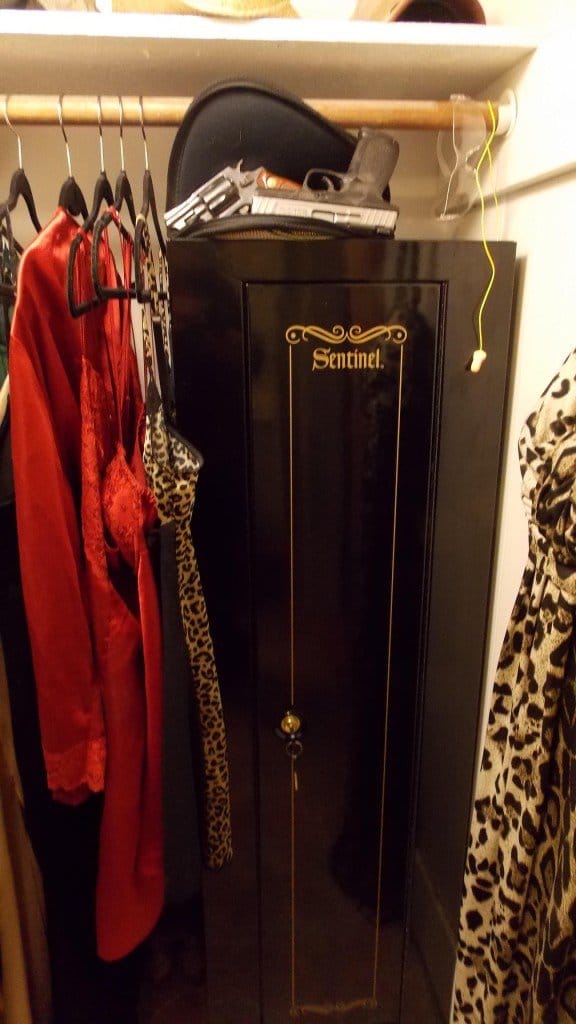
Sentinel gun cabinet closed in a closet under the stairs

The Sentinel Gun Cabinet: What You Get for ~$70

The Sentinel cabinet stands 52 inches tall and holds 10 to 12 long guns. It’s steel, it locks, and it was lightweight enough for me to haul into the house and set up alone. Assembly was minimal — the interior shelf and the sticky barrel rests. It has predrilled holes for anchoring to floors and walls, which the manual recommends hitting studs. My closet turned up no studs and practically no floor depth, so my anchoring situation is what it is. The fault is the house, not the cabinet.

Securely anchored to real studs it would keep 300-pound Bubba at bay for 5 to 10 minutes. The door fits tightly enough to make prying difficult, and the lock is surprisingly sturdy for the price point. For under $70 on sale, I’m genuinely impressed. It looks nice too — always matters.

Opened up: foam barrel rests keep the long guns upright and off each other, foam lines the bottom, and the top shelf holds handguns and ammo cans with room to spare. Above the cabinet I hang safety glasses and ear protection; pistol cases sit on top. Everything for a grab-and-go is in one place, in our main-level safe room off the master bath.

Let me be direct about what this is not: it’s not a gun safe. It didn’t take two people to move it. It’s not fireproof. It didn’t cost a month’s Social Security check. But for homestead storage of essential firearms — where the real goals are keeping grandkids out, keeping guns organized, and deterring casual theft — it’s exactly right.

Download 906 survival guides bundle

Gun Cabinet vs. Gun Safe: Which One Do You Actually Need?

This is the question most people are really asking when they land on a page like this, so let’s settle it plainly. A gun cabinet and a gun safe are not the same thing, and choosing the wrong one for your situation is a real mistake in both directions — over-buying an expensive safe you don’t need, or under-buying a cabinet that can’t do the job you actually have.

Gun CabinetGun Safe
Primary jobAccess control, organization, deterrenceTheft resistance, fire protection
Steel gaugeLighter (18–20 gauge typically)Heavier (10–14 gauge or more)
Weight30–80 lbs — one person can manage150–600+ lbs — needs help, often a dolly
FireproofNoMost are rated (check UL certification)
Cost$60–$250$300–$2,000+
Best forKeeping kids out, basic organization, low-theft-risk homesHigh-value collections, fire-prone areas, higher-risk situations

For most preppers and homesteaders with a working collection of hunting and home-defense firearms — not an investment collection, not irreplaceable heirlooms — a well-anchored gun cabinet does the job. The grandkids can’t get into it. Casual opportunists will move on to easier targets. Your long guns stay organized and grab-ready.

A gun safe makes sense when you have firearms worth thousands of dollars, live in a wildfire area, or have a genuine theft risk that warrants the weight and cost. If both those boxes aren’t checked, you may be spending several hundred dollars for peace of mind a $70 cabinet already gives you.

What to Look for in a Gun Storage Cabinet

If you’re shopping rather than inheriting, here’s what actually matters — not spec-sheet bragging points.

Height and Capacity

Measure your space first, not after. If it’s going in a closet under stairs like mine, a 52-inch cabinet is the right call. Standard long-gun cabinets run 52 to 60 inches; count your long guns and add two — you’ll acquire more. The stated capacity (10 guns, 12 guns) assumes slim long guns without scopes; if you run scoped rifles, assume two-thirds of the advertised number.

Anchoring Options

A cabinet that isn’t bolted down is a cabinet someone walks out with. Look for predrilled holes at floor and back-wall anchor points. Hit studs — use a stud finder before you drill, and pick your location with the studs, not around them. A properly anchored steel cabinet is not going anywhere in a hurry.

Lock Quality

Key locks are standard at the cabinet price point. They’re not pick-proof, but that’s not really the threat model — the threat model is a grandchild or a quick opportunist, and a key lock handles both. If you want a step up without going full safe, some cabinet models now offer a three-point locking bar or a secondary electronic keypad. Worth the extra $20 to $30 if you’re in a higher-risk situation.

Interior Fit and Finish

Foam barrel rests are the standard, and the Sentinel’s work fine. What you want to avoid is bare metal resting against your barrels. Look for foam or a soft liner on the bottom and sides. A top shelf for handguns and a small storage area for ammo, cleaning kit, and accessories makes the cabinet a one-stop grab-and-go rather than just a rack.

Safe Storage and Legal Considerations

Responsible gun ownership means knowing your state’s storage requirements before you buy anything. Several states now have laws specifying how firearms must be stored — particularly when children are in the home. A locked cabinet meets the legal standard in most jurisdictions, but check your own state’s statutes rather than assuming. The NRA-ILA state gun law database is a reliable reference. Whatever the law requires, the baseline is simple: if you’re not holding it, it should be locked up.

For more on the broader picture of firearms and home security, and building a system that covers guns, access, and home defense together, those resources are on the site. If you’re also thinking about what to store alongside your firearms — emergency guides, medical references, and preparedness documents — the preparedness downloads page has a full library.

Frequently Asked Questions

Is a gun cabinet good enough, or do I need a safe?

For most homeowners with a working firearm collection — not high-value or irreplaceable pieces — a well-anchored gun cabinet is good enough. It keeps children out, deters casual theft, and keeps your guns organized. A full gun safe makes sense when you have high-value firearms, live in a wildfire area, or face a genuine elevated theft risk.

How many guns does the Sentinel cabinet actually hold?

The 10-gun Sentinel holds 10 slim long guns as advertised. If your rifles have scopes, budget for about two-thirds of the stated capacity — scoped rifles need more lateral clearance between them. The top shelf handles handguns and leaves room for ammo storage.

Can someone break into a gun cabinet?

Yes, with time and the right tools. A gun cabinet is not a safe. A determined, prepared burglar can defeat one in minutes. What a properly anchored cabinet does is eliminate casual access (kids, opportunistic theft) and slow down everyone else — buying time for an alarm to trigger or a neighbor to notice. For higher-security needs, step up to a heavy-gauge gun safe.

Where is the best place to put a gun cabinet in the house?

The best location is accessible to you, anchored to real studs, out of plain sight from windows and entry points, and in a low-humidity area. Closets, dedicated storage rooms, and master bedrooms are common choices. Avoid garages and basements with moisture issues — humidity is hard on both firearms and the cabinet itself.

Filed Under: Firearms

Getting Acquainted with Early Frontier Firearms My Ancestors Used

March 4, 2024 by Seasoned Citizen Prepper

Kentucky Rifle

During the early days of our country times were difficult, especially if you lived in the frontier portions of the country which was Western Virginia, Western Maryland, Western Pennsylvania, Kentucky, Tennessee, Ohio and parts of Illinois and Indiana. Women and children both had a high mortality rate with women often dying in childbirth.

My own father who was born in 1897 of a family that eventually numbered eleven live births which left four survivors. My Dad, his brother Jim and two sisters, Cora who was older than Dad, and Jim and Fay who were a year younger than Dad. Dad had just gone through his second marriage at twenty six when his Father died.

My First Experience With Black Powder

When I was around nine or ten, one of my Mother’s brothers showed up for a visit and left us the loan, for several years (it was still at my oldest brothers house when I left for the army), a Colts 1849 belt model percussion revolver bored in thirty one caliber along with a stock of black powder and percussion caps. He said he had lost the bullet mold, but had about twenty balls with it. We took one of the balls to the hardware and found it was the same diameter as #0 buckshot.  Since buckshot was made with a different manufacturing process, the balls were always perfectly symmetrical and always the same size and we could buy a bag of 100 for $2.50.

We had other firearms in the family, but we shot that pistol an awful lot and then we ended up reloading shotgun shells with the black powder and made an anvil to go inside the percussion cap which we then pressed into the primer pocket.  We fired everything through that old short barreled double barrel shotgun including some of the bluing balls for laundry that we filched from Mom, thereby starting the forerunner of paintball.

The Kentucky Rifle

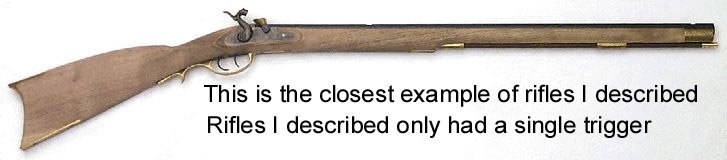
An ancient uncle of my Dad arrived one day from Kentucky, because he said there was no family left down there to bury him when he died and he wanted to be with some family until the end.  He brought with him some possessions and some firearms, one of which was a beautiful representation of what was called a Kentucky rifle back then.

S. Hawken has long been regarded as the master maker of muzzle loaders which I won’t dispute, but he made Pennsylvania rifles which had a larger bore than the Kentucky rifles usually around forty four caliber.  His rifle was of high precision work and had a twenty six inch octagon barrel with a full length maple stock. It was a beautiful piece of work and a genuine art form in itself.

Squirrel Barking and Brain Tanning

He called it his squirrel rifle that he barked squirrels with. Barking a squirrel consists in firing into the portion of the tree the squirrel is hugging causing a chip of bark or wood to strike the squirrel in the head either killing him or knocking him out where he could be killed on the ground.

He said the reason for this was to save as much meat as possible and secondly he wanted the brain intact to tan hides with. He explained that all animals have enough tannic acid in their brains to tan their own hide, but the tannic acid in the squirrel was more potent and done a better job of tanning due to his diet of acorns and other nuts.

Kentucky Rifle Particulars

He had lost his possibles bag on the trip but said the rifle was a thirty one caliber if we knew where to get a bullet mold for it.  We told him we could do one better since we had the thirty one caliber revolver and had plenty of balls left for it and they were #0 buck.

We dismantled the rifle, pulled the breech plug and checked the barrel and it was in mint shape with good deep rifling and about a two inch smooth bore at the muzzle end that was slightly coned to start the ball.  We reassembled the rifle with a new nipple and charged it with powder.

We talked about patches and he said they were only used if the ball did not fit snugly and then he preferred cheesecloth since it cleaned the bore as it traveled down it.  We dropped a ball in the muzzle and with a strong steady push, seated it down the barrel and onto the powder charge.

We sat a small Vienna sausage can on a fence post down about fifty yards from where we were going to shoot and he had me fire the first shot.  The can flew in the air and when we went down to set it back up; there was a groove in the top of the post where the ball had barked the can.

Uncle Sheridan, Sherd as we called him, reset the rear sight for my sight picture and adjusted it for one hundred yards which he said the rifle was designed for.  The second shot at one hundred yards nailed the can dead center. We tried to talk him out of the rifle even offering to trade him a 32-20 Remington rolling block rifle for it, but he would not part with it.

He said it was made right there in Kentucky close to where he lived, but since the maker made no marks of any kind on the rifle word of mouth was the only way a person could find out about it.  He said he had bought it from a fellow in Ohio County for a fat hog to butcher (Ohio County is where Bill and Charley Monroe of Bluegrass fame came from).

Dad and Mom talked Uncle Sherd into marrying an elderly retired school teacher who owned her own place and needed a companion. Her name was Ethel Robinson and when they got married by a visiting backwoods preacher from Tennessee, we found she was eighty seven and he was ninety seven.

They both died while I was in Korea on my first tour as did Aunt Cora, my Dad’s sister. Since I was eighteen when I went to Korea and I was twelve when they were married that had to make Uncle Sherd one hundred and three years old when he died. I still do not know what happened to that fine rifle.

Another Kentucky Rifle

One day, while all of the women were gathered up listening to Aunt Lena’s tales, Uncle Dory came over carrying a muzzle loading rifle.  He was eighty four years old and he said his Dad had given it to him when he was fourteen and he had never fired it.  He wanted to know if I thought it was safe to fire and would I like to try it out.

I examined the rifle and it was an exact duplicate of the one that Uncle Sherd had when I was a kid. I said I would have to disassemble it and check it out.  He said he had nothing for it, so after pulling the breech plug and finding it was in the same condition as the rifle Uncle Sherd had, clean with good sharp rifling, I finished looking it over and the nipple was damaged.

I did not have a nipple wrench, so I said I’ll have to go over to Sheperdsville to the gun shop anyway to buy percussion caps, black powder and some balls since he had no mold.  Once there, they determined the cylinder also needed replaced so they installed a new cylinder and nipple and I bought two spare nipples along with a nipple wrench. They measured the bore and it was thirty one caliber.  I mentioned Dad’s uncle who came to Illinois years ago who brought a rifle identical to this one with no makers marks on it.

He said he had seen a couple of them in the past and were told they were locally made. With the rifle reassembled and test fired at the gun shop, he also sold us a hard maple ramrod which did not flex like a hickory rod did since we had no ramrod.  We also bought five pounds of FFFG black powder, some of the new design percussion caps that fit the new nipples and a bag of one hundred #0 buck shot.

Trying the Rifle Out

We returned to West Point and went into the woods to try the rifle out. They had given me a couple of empty 32-30 cases since I told them that was the measure I had used with the pistol some years back. He filled the case and then weighed it.  After consulting a book, he said I had twenty grains of powder and the standard load for the rifle would be somewhere between eighteen and twenty two grains of FFFG, so my measure was optimum. He then performed the same test with a thirty eight special case and said it was perfect for thirty six caliber rifle if I came across one since he had seen one in that caliber that looked like this rifle.

I stepped off fifty yards and set an empty square metal Prestone anti-freeze can for a target. I went back and loaded the rifle and kneeling on one knee to use as a support for my arm and the rifle, I sighted on the O in Prestone. I squeezed the trigger and the rifle fired.  The can flew backwards and tumbled.  When we retrieved the can there was a neat little round hole right in the center of the O and a somewhat ragged but round exit hole on the other side.

Testing The Old Kentucky Rifle Against a Deer

I told Uncle Dory I believed the rifle was properly sighted in for fifty yards.  We had noticed some deer tracks around the little spring nearby and Uncle said it was a shame the deer had not been standing there when I shot since he loved venison. I asked him, “Do you know someone here who can finish aging and butchering one out if we happened to bag one and field dressed it?”

He said he did and I said well let’s try to get one then and he started to get up from his camp chair we had taken down with us and I told him to just sit still. I reloaded the rifle and then I walked down to where we saw the tracks and it was just about fifty yards even. I tied my white handkerchief onto a willow sapling and when I came back I said a deer is nosy just like a cow and sooner or later the buck will be there to check out what that handkerchief is.

We sat about twenty minutes when I saw an antler moving in the willows.  I called Uncle Dory’s attention to it and we just sat still.  Shortly the buck came into the little clearing and stretched his neck out to sniff the cloth.  The cloth moved in the breeze and the buck shifted until he was head on to us.

I tried my best to muffle the noise when I cocked the hammer but the buck flung his head up and looked around. Since we were not moving, he resumed his examination of that cloth, and when he stretched his neck way out and tried to pull the cloth from the willow after getting it in his mouth, I shot him in the chest into the heart and he dropped instantly in his tracks.

I drained and field dressed him washing the body cavity out with water from the spring and then backed the car down and loaded him and the chairs and the rifle.  We dropped him off at the butcher and I told Uncle Dory it was all his since I did not like the taste of venison.  He objected and said he was on my deer tag and I told him I don’t even have a license.  He said neither do I but my nephew here will tag it for us and besides I own the property where you shot it.  The nephew had trouble believing what we had shot it with until the butcher retrieved the ball still lodged in the heart.

Harper Kentucky Rifles

We shipped out shortly after that and I again returned to Kentucky three years later at Fort Campbell and while there I went with one of the pilots to Russellville to a muzzle loading shooting spree. While there, one of the participants had a rifle identical to the first two, only it was in thirty six caliber. I told him of my past experiences with a pair of them in thirty one caliber and because of the perfection of workmanship, I always wondered who had made them.

He said he was told by some of the old timers that they were made over a span of twenty years by a fellow named Harper at Brandenburg Station.

It took a long time searching but I found there was a talented engineer on one of the Ohio riverboats who made a lot of quality things, the rifles included.  It was mentioned that he remarked it was not necessary to put his name on them since anyone who had one would know who they got it from.  They further mentioned he only made them in the two calibers and since Brandenburg Station was an overnight fueling stop, he sold his wares from there.

I have never seen another one like it and the workmanship was fantastic. I haven’t shot muzzle loaders since then, and looking at what is offered and the price of black powder, I would not want to take up the sport again.

Filed Under: Firearms

Technology and Home Defense

March 4, 2024 by Seasoned Citizen Prepper

Let’s go into defending your home turf, if everything goes bad. There’s no doubt that there will be those that will want to take what you have. How that will happen, will depend very much on the situation. You can bet that the first confrontation will be an attempt to see if you are easy pickings. After that, things will likely get tougher. What goes bump in the night could be deadly!

Home Security Transmitter Alarms for the Perimeter

Placing coils of barb wire around your perimeter is a very good low tech solution. On the high tech side, there are government surplus seismic sensors (TRC-3a) that can be placed up to a half mile away, and signal you of any ground vibrations such as people walking, or vehicles (On their highest settings they will pick up raindrops, thunder, small animals, and even breeze blowing in the trees! So there is a potential for false alarms if they are not set correctly).

Each set has four transmitters and a receiver. There are different set frequencies available as well. Each of the four transmitters emits a series of beeps dependent on which transmitter it is. Each transmitter has a probe that is placed in the ground to pick up vibrations, and has raised bumps like Braille that show how many beeps it transmits.

The antenna on the transmitters is made to look like a blade of grass, and they are waterproof too. From time to time you can find them for sale on Ebay, as a set, or sometimes individual units. For a receiver, an airplane frequency radio will work, or a programmable scanner.

The drawback is that these require 9 volt batteries, but they do last for a very long time in the units.

Night Vision for Home Security

Night Vision will also give you a definite edge. In today’s world it is becoming more commonplace, so one almost needs it to stay even with what your adversary might have! Lots of stuff came back from Iraq and Afghanistan with the returning troops.

The generation 1 stuff is lower priced, but not a good choice, as you only see part of what’s out there in the dark. If you’re thinking of buying night vision, save your money until you can afford generation 2 or 3 units. You’ll be glad you did!

The ultimate for detecting intruders, in my opinion, is a thermal viewer or scope. They are pricey, but worth the cost. It’s hard to hide from them, but it can be done. For example they can’t see through glass or walls. The government likely has ones that will, but what you can buy won’t. If there’s something around that’s live, it will glow like a ghost. Having one on a rifle stacks the deck big time in your favor!

All of the high tech stuff does require batteries, so a good supply of them would be a must. Rechargeable and a way to charge them (solar?) is also something to consider.

I know that these are pricey solutions, but each person must decide on what they can afford for assurance and well being. There are low tech solutions that will likely work to a degree, but I prefer to stack the deck in my favor, whenever I can!

Filed Under: Security

What They’re Not Telling You About The Ammo Shortage

March 1, 2024 by Seasoned Citizen Prepper

Everyone that’s a shooting enthusiast, and otherwise interested in firearms for whatever reason, knows there’s currently an ammo shortage going on. I’ve wondered about it and done some research and looking. And yes, there’s lots of conspiracy theories for that too!

No, I don’t believe the government is responsible. They would not have a need or use for millions of rounds of .22 LR ammo. They have put a request to buy a large quantity of other ammunition, but it’s only a request, and not an actual buy. So kick out the conspiracy rants and let’s look at what’s really going on.

Beginning in 2008, when Obama got elected, things started getting tight on ammo. This was due to fears of what his anti-gun agenda might be. We all know that nothing materialized the first four years, and ammo could be purchased but supplies were spotty at best.  Then the anti-gun rhetoric started after the mass shootings (no I don’t believe any conspiracy BS here either), this is where everything went crazy in the gun world.

Panic buying ensued and more guns have been sold in the last few months than anytime prior. We’re talking millions! With any new or used gun purchase, there’s a desire to buy ammo for it. I mean what good is a gun without ammo to shoot in it? So everyone wants to buy a quantity of ammo to go along with that new gun purchase. This was compounded with what was already a spotty supply, prior to the shootings.

Now comes the key to what has everything dried up. The NRA spelled it out real good in their latest magazine article on the subject. People are just plain buying more than they really need or would normally use!

The author of the article quotes an instance that rings true with what I’ve seen personally. A friend called him to say he’d just made a super score on 22 ammo! The local gun shop got in 5,000 rounds and he bought it all! The author asked him how many he would normally buy or need if there wasn’t a shortage going on, and the friend replied “probably about 500”.

This is classic panic buying at its best/worst! At our local Wal-Mart, before they put limits on, a guy that had just opened a shooting range came in and bought all the ammo they had because he couldn’t get any for people to use on his range from anywhere else. He is now charging about double from what it originally sold for! This brings us to the next point.

There are those that are buying everything they can get, so they can sell it for outrageous prices! Even components to reload ammo are getting scalped! It doesn’t take long to see this happening at unscrupulous gun shops and on the net. There has been no substantial price hikes from the manufacturers, only the dishonest sellers. I’ve seen bricks (500 rounds) of 22 ammo sell for $100 at times lately! I just bought some primers for reloading from a local honest dealer for $28.95 a carton. I’m seeing scalpers wanting $100 a carton currently!

I for one, am making a mental note to never deal with the scalpers when things die down. The ammo shortage is real, but perpetuated by the predictable panic buying mode and unscrupulous sellers. No, it’s not the law of supply and demand! It is artificial just like the supposed gas shortages. Folks have found out that they can get away with it, and make money. So they capitalize on it and go stronger with it.

The solution? Buy only what you need, and don’t pay those ridiculous prices to the bandits. Sure you might have to wait awhile before things calm back down to normal, but it’s the only way to fight back on this current BS!

Since writing this article, I’ve heard that more and more the Department of Homeland Security is coming under scrutiny for their excessive ammo purchases, and future intended purchases. This is rightfully so, as they are wanting to buy more than the military actually uses per person!

Is this a conspiracy? No, I think it’s a classic case of the ‘Good Ole Boy’ attitude by the DHS. They want to buy enough ammo that their agents can go out any time they choose and shoot all they want, as much as they want. Then, if they are shooting with a local LE or civil unit, they can give them some too as a kind of gratuity.

Boy, wouldn’t it be nice if we could have all the free ammo we wanted! Government waste at it’s best!

Filed Under: Firearms

  • « Go to Previous Page
  • Page 1
  • Page 2
  • Page 3
  • Page 4

Copyright © 2026 · Genesis Sample on Genesis Framework · WordPress · Log in

  • Privacy Policy