• Skip to primary navigation
  • Skip to main content

SCP Survival

Best Survival Gear and Supplies

  • Download Survival Guides
  • Survival Food List
  • Download 906 Survival Guides to Your Device
Home / Communications

Communications

2-Way Radio Communications WITHOUT a HAM Radio License

March 22, 2024 by Seasoned Citizen Prepper

We get many questions from those that are just starting to plan their emergency communications.  Most are simply looking for a way to keep in touch with each other when one or more are out of sight but still nearby. Many that want or need to use 2-way radios don’t have the desire to get an Amateur Radio License. And, fortunately, communicating nearby or across town doesn’t require a ham license! Whatever your specific needs may be, you need to know your options and what you can realistically expect. “Range” is the probably the most asked question. And the simple answer is that a radios “range” is dependent on terrain. A radio can “talk” further on flat deserted land than it can in a valley or in a city. Keep in mind that these are strictly for close-range communications and there is really no reliable alternative for long range communications without obtaining an Amateur Radio license. Additionally, since these are considered “Citizen’s Bands” the odds are good that you and your group will not be the only ones using them. Below is a summary of the most common alternatives to HAM radios along with realistic distances.

1. Citizens Band Radios (CB):

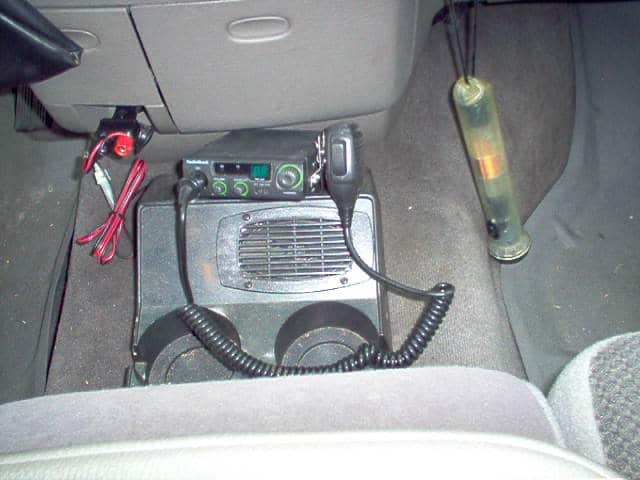
CB radios are most likely to be the least expensive option for a group to set-up and use. CB radios and accessories are very common and can be found at truck stops and garage sales. FCC regulations:
  • No license required.
  • 40 specific frequencies between 26.900 and 27.400 MHz.
  • 4 watts maximum output.
  • Base, mobile and handheld stations allowed.
  • Amplifiers not allowed.
  • Repeaters not allowed
  • Side Band OK
  • Realistic range up to 10 miles with an elevated antenna

2. FRS (Family Radio Service)

This service is limited to 1/2 watt output. It uses frequencies in the UHF band near 462 MHz. There used to be several brands of radios that were FRS only. Nowadays, it’s hard to find an FRS-only radio. They are GMRS radios that share some of their frequencies with FRS and automatically reduce power when using an FRS frequency (or channel). All FRS radios are handheld. FCC regulations:
  • No license required.
  • 1/2 watt maximum
  • External antennas not allowed
  • Amplifiers not allowed
  • Repeaters not allowed
  • Realistic range up to 1/2 mile.

3) GMRS General Mobile Radio Service

This service picks up where FRS leaves off. GMRS uses UHF frequencies near 462 MHz and 467 MHz There are 2 classes of GMRS radio: a) Consumer grade handhelds like Midland, Uniden and Cobra. Most of these radios exaggerate their range and power. Typically, the best consumer radio is actually pushing about 3 watts and has a realistic range of about 2 miles in most environments. b) Commercial grade equipment from Vertex or Icom etc. This equipment is built using the same quality chassis as ham and public service equipment. Very good range, depending on the equipment and terrain. FCC regs:
  • A “No Test” license is required. ($80 for 5 years)
  • Up to 50 watts allowed
  • External antenna OK
  • Base, mobile or handheld OK
  • Repeater OK on specific frequencies

4) MURS Multi-Use Radio Service

This is a low-power service that uses 5 specific frequencies in the VHF band near 150 MHz. It is extremely popular due to the no-license feature, and inexpensive radios. FCC regs:
  • No license required.
  • 2 watts maximum
  • External antenna OK
  • Handheld, mobile or base station OK
  • No repeaters
  • Realistic range: 1 mile with handhelds, 5-8 miles with an elevated antenna.
The FCC regulations shown above are to be used as a general guideline so it’s best to research before you buy. There have been several changes made concerning radio equipment performance in the last decade, so stay away from older radios and radios that have been modified. Don’t just buy a radio and put it on the shelf, there’s more to it than that. It’s best to check and use your “system” as often as possible to be sure it will function when it’s really needed. Monthly practice drills are ideal, especially with base radios. You’ll be able to find any weather related problems. It may be tempting to purchase a radio system that is illegally modified or intended to be used by a licensed user or business. But realistically, there’s no way to practice with that type of equipment since:
  • You’re not licensed to use it.
  • You may be seriously interrupting lawful communications every time you key the microphone.
  • You WILL get a fine when they find out where the interference is coming from.
Remember, no matter what types of 2-way communications you choose, there’s always room for a basic survival radio to get the weather, scanners, and news updates. 

Filed Under: Communications

Our Survival Radio Communications – Through Hurricanes Katrina and Gustav

March 11, 2024 by Seasoned Citizen Prepper

Radio Communications

My wife and I use two way radios to communicate whenever we take two vehicles to travel anywhere. By doing so, we always know when one of us has to stop for something to drink, eat, go to the bathroom, get gas or just stretch our legs. If one of us had a problem of any type, we could communicate the problem to the other quickly and effortlessly. If one of us gets out of sight of the other in heavy traffic, we just had to radio the other to stay in touch. Radios worked very well for us.

At first, we both had standard Citizen Band (C.B.) radios mounted in each of our vehicles on removable bases. We had magnetic antennas on the top of each vehicle. This allowed us to take our radio antennas off of our vehicles so we could run the vehicles through an automated car wash. When we pulled into a motel parking lot for the night, we took the magnetic based C. B. antennas of the tops of our vehicles and removed the C. B. radios from inside of our vehicles; this made our vehicles less of a target for car burglars.

We found several major problems with our C. B. radios during and in the weeks after Hurricane Katrina hit southeast Louisiana.

First, there were major problems with too many people trying to transmit on all of the C. B. radio channels at the same time. We could not get a chance to transmit anything, no matter what channel we attempted to transmit on. Everyone wanted to talk at the same time. No one wanted to yield to anyone, even if an emergency was declared.

Second, the vulgarity used on the C. B. radios was unbelievable.

Third, when we left our vehicles, we could not take our vehicle C. B. radio with us. Yes, I know that they make hand held C. B. radios. If we decided to use the hand held C. B. radios, we still would have had the above listed problems with them.

I then got my “HAM” radio license. When I looked into purchasing my own “Ham” radios and the associated equipment, I found the cost to be prohibitive. At least it was a lot more than what I was willing to pay on a retirees fixed income.

We also had problems with our cell phones during evacuations. All of the lines were busy during the evacuation or we could not get a cell tower signal because the electricity was out. Also, using cell phones, you must take your eyes off of the road to dial the phone number. This is extremely dangerous in the very heavy traffic of an evacuation.

Both my wife and I enjoy going to flea markets and garage sales on Saturdays mornings. We find fantastic deals on camping gear and a whole lot of other items we use for prepping. Flea markets and garage sales are a topic for another article.

2 Way Radios

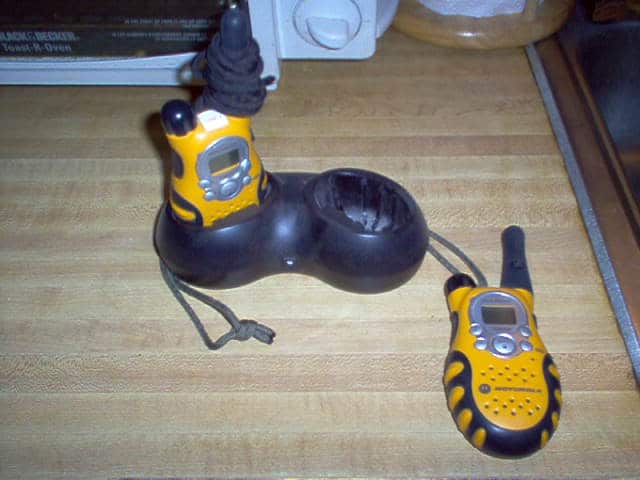
While at a garage sale, I observed two small, about the size of an adult fist, two way radios. They were yellow, “Motorola, Talkabout” Two-Way, GMRS/FRS channel radios, model number T5990.

I inspected both radios carefully. They appeared to have been well kept. I opened the backs of both radios and observed they both had rechargeable batteries in them. On the table next to the two radios was the battery charger for the radios. I asked the lady how much she wanted for both radios and the charger.

She told me she wanted $3.00 for the two radios and the charger. I quickly paid her the $3.00 and took them. Even if they did not work, I would only be out $3.00.

When I got home, I placed the two hand held radios in the charger. About eight (8) hours later I turned the radios on. Neither one of the radio batteries took a charge.

I removed the rechargeable battery packs and replaced them with three (3) AA batteries. When I turned the radios on, they both worked perfectly.

I went on the internet, located and printed out the operations manual for the two way radios and read all about them. To my surprise each radio had twenty-two (22) channels. Fifteen (15) channels transmit with one (1) watt of power and seven (7) channels transmit with one half (1/2) watt. In addition to the radio channels, each radio had ninety-nine (99) Interference Eliminator Codes.

To my surprise both radios could receive the weather channels also.

While in my local Walmart one day, I observed the “Motorola Talkabout, model T5950 radios for sale. They came in a blister pack with two radios, two reachable batteries and a charger. Wally World was selling them for $68.00 new.

My wife and I then started testing these little radios. To our surprise we could easily transmit and receive a mile with no problem within the city that we live in.

We then tested the radios on the interstate from and to each of our vehicles. They worked great. The real test came during our Hurricane Gustav evacuation. With all of the problems that we had with the C. B. radios; we did not have any problems with these little two way radios.

Handheld Radios

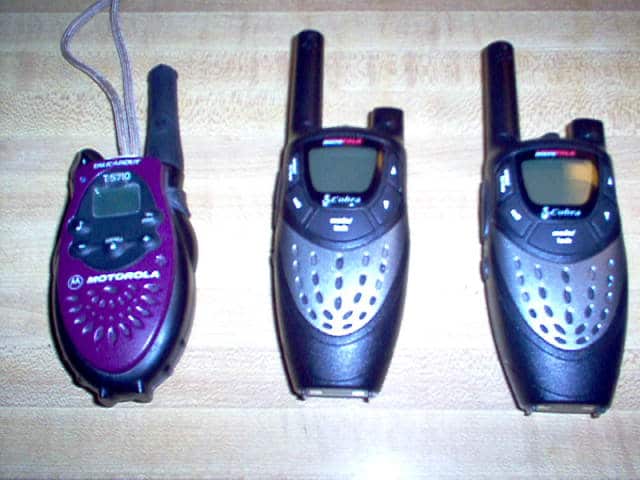
Since then, we continue to go to garage sales and flea markets. I have found a pair of “Cobra, micro Talk” radios. I purchased the pair for $5.00.  I also found a single “Motorola, Talkabout, model T5710”, which I purchased for $2.00. All of these radios are compatible with the first two that I purchased. When tested, these two way radios worked flawlessly also. I found the manuals for these radios on the internet also.

I easily attached a length of para cord (550 cord) to the back of three of these radios. (See Photo # 2 & 3 above) We place the para cord around our neck and the radio in our shirt pocket. This way while we are driving the radios do not slide around in the vehicle and you can locate them easily when someone calls you or you need to call someone. Another advantage is that you can easily hear when someone calls you.

When we go camping with our grandsons, everyone carries their own two way radio. This way we are able to talk to anyone in our camping party at any time that we need to. We have also used them very successively at Disney World in Florida and on other vacations that we have taken.

They make even more powerful two way radios than the ones that I have but they cost a little more. I have seen them for sale at Cabala’s, Wal-Mart, Sam’s Club and Costco. I am sure you can find them at other locations also. However, garage sales and flea markets are my preferences.

These little radios work great for us and you cannot beat the price we bought them for.

(In addition to 2-way radios, a bare bones but solid “survival radio” is a good idea to incorporate in your preps–something that can run on batteries forever, give you the news, weather, and other updates). 

Filed Under: Communications

6 Best Survival Radios

March 10, 2024 by SCPadmin

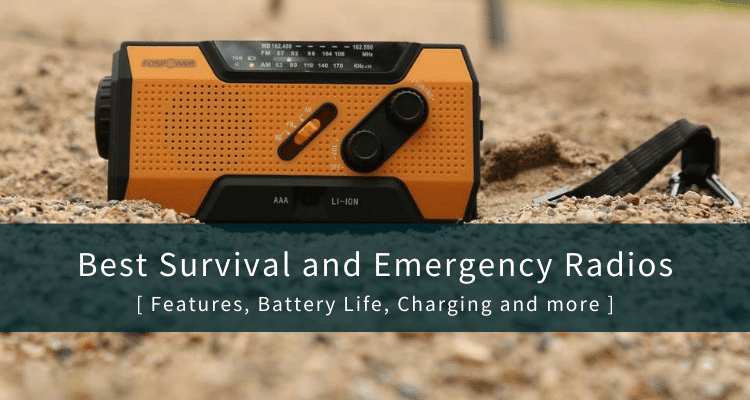
Best survival radios for emergencies lined up together

The best survival radios earn their spot in your gear whether you’re miles from civilization or just living a more minimalist, off-grid life. They keep you apprised of weather emergencies and atmospheric conditions. They also pack in flashlights, power banks, and SOS beacons most people forget to bring separately. These aren’t your dad’s dusty hand-crank radio.

Every radio on this list handles the basics well. What separates a great pick from an average one comes down to power options, battery capacity, and how it holds up when the grid actually goes down.

The Short Answer: Our Pick for the Best Survival Radio

Short on time? Here’s our top pick for the best combination of features, durability, and value in 2026:

The FosPower Emergency Radio

Why It’s #1:

  • Can be powered 4 ways
  • Internal 2,000mAh power bank
  • SOS alarm
  • Lifetime warranty
Check Latest Price

Power flexibility topped our criteria this round. A dead battery in the backcountry turns an expensive radio into dead weight. The FosPower charges four ways: AAA batteries, its built-in solar panel, a hand-crank dynamo, or a Micro-USB source.

The FosPower packs a standard AM/FM receiver for entertainment during downtime, plus a powerful 1W LED flashlight and a separate reading light for more diffused light. Its respectable 2,000mAh power bank keeps a phone or GoPro charged and ready.

It also receives NOAA stations and emergency alerts, which matters most if you’re in storm-prone or earthquake-prone territory. A few minutes’ warning can make a real difference. If things go sideways, the built-in SOS alarm signals rescuers to your position.

At around $40, and still one of the best-reviewed compact options on the market in 2026, the FosPower Emergency Radio is our pick for the best survival radio overall.

Other Great Survival Radios

Kaito KA500

  • 6 options for power
  • AM/FM/SW/NOAA radio
  • 14.5” antenna and signal strength meter
Check Latest Price

The Kaito KA500 packs in more features than most, but it also weighs nearly half a pound more and costs more too. Along with AM/FM and NOAA support, it adds a dual-range shortwave receiver, backed by a built-in signal strength meter and stronger reception circuitry. Once tuned in, a headphone jack lets you listen privately while saving battery.

Its internal NiMH battery charges from the solar panel, hand-crank dynamo, Mini-USB, or an AC/DC adapter, and it also runs on 3 AA batteries in a pinch. Once powered, you can tune in AM/FM/NOAA/SW broadcasts, use the flashlight or reading lamp, or charge a phone from the 5V USB output. A red LED SOS light rounds it out for signaling in an emergency.

Midland ER310PRO

  • 10,000mAh battery — up to 200 hours of runtime
  • Bluetooth streaming
  • USB-C bidirectional charging
Check Latest Price

Update: We swapped this pick from the original Midland ER310 to Midland’s late-2025 upgrade, the ER310PRO — the standard ER310 is still sold, but the Pro is now the stronger buy. Its 10,000mAh battery is nearly four times the size of the standard ER310’s 2,600mAh cell, and Midland rates it for over 200 hours of radio use on a full charge.

The ER310PRO adds Bluetooth streaming, a first for Midland’s emergency line, so you can pair a phone and listen to music or podcasts once regular broadcasts go quiet. It charges via USB-C, solar panel, or hand crank, and that same port pushes power back out to top off a phone or tablet.

It keeps the Cree LED flashlight, SOS strobe, and ultrasonic dog whistle that made the standard ER310 popular. The trade-off: the Pro drops the removable AA battery backup in favor of the larger internal cell, and at roughly $100, it costs about double the classic ER310. If budget matters more than runtime, the original ER310 remains a solid, cheaper alternative.

American Red Cross Emergency NOAA Weather Radio

  • Red LED beacon
  • AM/FM/7-channel NOAA receiver
  • 2,600mAh battery
Check Latest Price

The Red Cross-branded FRX3 keeps its distinctive shape, which shields the volume and tuning knobs from getting bumped or changed by accident. Its 2,600mAh lithium-ion battery charges quickly from the ergonomic hand crank, or tops off passively from the built-in solar panel. The included AC charger offers the fastest option when you’re near an outlet.

An easy-to-read LCD shows the active power source, the tuned station, and battery level. The pack reliably charges phones and other small devices, and the LED flashlight helps in low light. The beacon function uses a single red LED. Eton, which manufactures the radio for the Red Cross, now also sells an upgraded “FRX3+” version with the same core feature set, if you’d rather have the newer model.

RunningSnail Emergency NOAA Portable Radio

  • 4,000mAh lithium-ion battery
  • AUX input
  • Large LCD readout
Check Latest Price

The RunningSnail Emergency NOAA Portable Radio packs a lot into a modest package. It runs on 3 AAA disposable batteries, but you’ll rarely need them, thanks to the massive 4,000mAh internal power bank. Keep it topped off via hand crank, solar panel, or Micro-USB, and you get hours of radio time, SOS alarm, reading light, or flashlight use.

Beyond the usual AM/FM/NOAA receiver, this unit adds an AUX input most models skip. Connect an AUX cord and you get your entire music library, not just live broadcasts — a genuine advantage if you’ll use this radio outside of emergencies too. The large LCD display shows battery level, active power source, and tuning details at a glance.

RunningSnail Emergency Self Powered Weather Radio

  • 1,000mAh lithium-ion battery
  • IPX3 water resistance
  • 3 options for charging the battery
Check Latest Price

The RunningSnail Emergency Self Powered Weather Radio skips the extras and keeps the price under $20, making it an excellent budget pick. Its 1,000mAh power bank charges via hand crank, solar panel, or Micro-USB cable. Cranking at a brisk 2-3 revolutions per second fills it in about 4 hours; charging over USB beforehand is faster.

The analog tuner and volume dial reach AM, FM, or NOAA stations for continuous listening or alerts. A 1-watt LED flashlight lights your way, and the reading light kicks on automatically to keep a tent or campsite lit for evening tasks. In a pinch, the power bank can give a phone enough of a boost for one crucial call.

Midland ER310 survival radio with USB charging port
Like many survival radios, Midland’s ER310 (and its upgraded ER310PRO sibling) features a USB port for recharging your phone on the go.

What To Look For In A Survival Radio

The most important thing to keep in mind is battery capacity.

Battery capacity should match how you actually plan to use the radio. Casual weather checks or evening fireside listening only need a 1,000mAh bank.

Planning to run a reading light for hours, listen more often, or keep a phone, tablet, or camera charged? Look for at least a 2,000mAh power bank. (For more on keeping devices charged during an extended outage, see our guide to power outage preparedness.)

The second factor: how likely you are to need emergency features.

If you might need to receive emergency alerts or send an SOS signal, pick a unit built for both, with the largest battery you can get. An SOS function shouldn’t drain the battery before it has a chance to attract attention.

The third factor: your charging and power options.

Every radio here charges via built-in solar and hand crank, though some add extra options. Going from grid power to no power? Look for a model that fast-charges over USB or AC and takes disposable batteries as backup.

Generating your own power and using it sparingly? A slow trickle charge from the solar panel works fine and skips the extra hardware. Pair your radio with a broader bug-out bag checklist so charging isn’t the only power plan you have.

Kaito Voyager survival radio with AM, FM, and shortwave bands
One of the great features of many emergency radios is band versatility. Pictured here, the Kaito Voyager has AM, FM, and 2 shortwave bands.

FAQs

What’s the difference between lithium-ion and NiMH batteries?

Lithium-ion batteries are newer technology; NiMH batteries have been around much longer, and you’ve probably seen them in cordless home phones. Both use a series of small cells bound together, but lithium batteries outperform NiMH in most ways: they hold larger charges, last longer, and discharge to a lower level without damage.

Are any of these radios waterproof?

Yes. Every radio we’ve highlighted carries at least an IPX3 water-resistance rating, meaning it can handle running water of up to 10 liters per minute for 5 minutes. Don’t submerge them, but they’ll stand up to heavy rain or storms without issue.

How quickly can I charge these radios?

Hand-crank dynamos generally recharge around 250mAh per hour at 2-3 revolutions per second. Solar panels work best for maintenance charging and take at least 6-8 hours of direct sun to fill the battery. Units with USB or AC charging can reach a full charge in a couple of hours or less, depending on battery capacity.

Do the SOS functions send any kind of radio signal?

No. None of these radios broadcast like an EPIRB (emergency position-indicating radio beacon). Their SOS functions are limited to a flashing LED or an audible alarm loud enough to carry across a significant distance in the wilderness.

How much do these units weigh?

Weight varies by model. The lightest is the RunningSnail Emergency Self Powered Weather Radio at 7.8 ounces, and the heaviest is the Kaito KA500 at a still-manageable 1.4 pounds. None of these radios will add meaningful bulk to your pack.

What’s The Bottom Line?

Our favorite among the best survival radios remains the FosPower Emergency Radio — but it may not be exactly what you need. Weigh your own situation, and your own needs, before deciding.

Want maximum runtime and don’t mind the extra cost? The Midland ER310PRO is worth a look. Prefer digital tuning or a bigger battery bank? Reading through our breakdown of the leading models above will help you land on the right survival radio for your situation.

Filed Under: Communications

How To Make Invisible Ink – Low-Tech Survival Communications

March 4, 2024 by Seasoned Citizen Prepper

Have you ever stopped to ask yourself how you would communicate after a zombie apocalypse? I mean, it’s not like you will be using internet, or any electronics devices, in all likelihood. Even if you still have them at your disposal, you may not want to use them. Since every phone conversation and every email message, fb, pinterest, etc. are all being monitored in real time NOW, just imagine what it will be like then.

So, just how would you communicate in such a way as not to give away important information (OpSec)? I honestly do not know; I am hoping to ignite useful discussion on the subject here.

There is no doubt in my mind we may find ourselves “going back to the future”; returning to low-tech methods of getting many things done, including, perhaps, communications.

One of the thoughts  I had, of course, is carrier pigeons. An Uncle of mine once kept, bred, and trained pigeons. My Aunt hated them. They stank; they were noisy; they were very time-consuming. They need to eat and they need fresh water, every day. They need cages cleaned out regularly, even though the guano, or poop, or whatever you call it for pigeons, fell through the bottom of the mesh cages. Then you had the reproductive issues – managing your flock so you didn’t end up with more pigeons than you could handle.

On the other hand, I’m told pigeons are quite tasty, and were a common food source during WWII. So, one might argue that one could kill the proverbial two birds with one stone: food source and communications!

Naturally, one would need to learn how to train carriers to use them. I’m guessing that takes a lot of time and hard work. So, we may need less time critical methods.

And what if the messages were “captured”, as so often has happened in the past? So then my mind wandered to invisible inks, a.k.a., sympathetic inks. But, how do you make them? I found the answers in a book titled, “Modern Chemical Magic” by Lippy & Palder; these guys are magicians!

A sympathetic (invisible) ink is one that becomes visible when you apply another type of chemical, or handle it in a certain way. They can either be permanently visible, or only temporarily visible (they will vanish again).

Most such inks look like clear water, and, when dry, become invisible on most soft, white papers.

These guys segregate the secrets by color, so, I’ll just follow their lead.

Today, let’s talk about how to write invisibly with the color, Red. There are a number of ways to do this. Please note that I do not include any warnings or information on these chemicals. Do your homework before messing with any chemical, take prudent precautions, and know what you are doing before you do it (as with anything!).

Red Invisible Ink

(1) 15 grains potassium iodide dissolved in one ounce of distilled water. Sponge over with a solution of 20 grains mercury bichloride dissolved in one ounce water.

Potassium iodide is the potassium salt form of iodide, a naturally occurring substance. Potassium iodide can be used as an expectorant to thin mucus and loosen congestion in your chest and throat. Potassium iodide is used in people with chronic breathing problems that can be complicated by thick mucus in the respiratory tract, such as asthma, chronic bronchitis, or emphysema.  There are medical warnings that appear to be for too much of it. See:  http://www.drugs.com/mtm/potassium-iodide.html

(2) Weak solution of copper nitrate; when writing is exposed to mild heat, it becomes visible.

Copper(II) nitrate, Cu(NO3)2, is an inorganic compound that forms a blue crystalline solid. Anhydrous copper nitrate forms deep blue-green crystals and sublimes in a vacuum at 150-200 °C

From:  https://en.wikipedia.org/wiki/Copper%28II%29_nitrate

(3) Use a strong alcoholic solution of phenolphthalein, which becomes invisible when dry. To see it, expose to fumes of a strong solution of ammonia. As ammonia fumes evaporate, writing disappears again. If you want to make it “disappear” immediately, breathe on it.

Phenolphthalein is a mild acid that can be used for medical and scientific purposes. When used in medicine, this compound is most commonly recognized as an ingredient in over-the-counter laxatives. In laboratory settings, it is typically used to test the acidity of other substances.

Phenolphthalein is a crystal powder that is usually white but may sometimes have a yellow tinge. It does not typically have a smell or a taste. It may, however, cause coughing or sneezing if it is inhaled.

From:  http://www.wisegeek.com/what-is-phenolphthalein.htm

(4) A weak solution of silver nitrate, when exposed to heat (after drying) crates a rose-red color.

Silver nitrate is used as the starting point for the synthesis of many other silver compounds, as an antiseptic, and as a yellow stain for glass in stained glass. Most preppers are familiar with silver nitrate, as it is a water purifier. It’s not hard to find.

(5) Use 10% solution of potassium ferrocyanide (sounds serious, doesn’t it?!). Apply a 50% solution of iron tincture to produce a red color.

potassium ferrocyanide:  noun Chemistry .

a lemon-yellow, crystalline, water-soluble solid, K 4  Fe(CN) 6  ⋅3H 2  O, used chiefly in casehardening alloys having an iron base and in dyeing wool and silk.

Also called yellow prussiate of potash.

From:  http://dictionary.reference.com/browse/potassium_ferrocyanide

Sodium ferrocyanide is the main anti caking agent in salt. Further, it is used in the production of Citric acid and pigments, like Prussian Blue.

From:  http://www.gentrochema.nl/index.php/sodium-ferrocyanide/?gclid=CKPdkfPjgLkCFZSY4AodEVQAag

(6) Write with an aqueous solution of iron chloride and allow to dry. Then use a solution of sodium sulfocyanide, and the writing will appear, in red. Well, it was a lot more difficult to find a straight description of sodium sulfocyanide, although suppliers are plentiful, especially in bulk; you’ll have to look this one up for yourself.

Blue Invisible Ink

Here are chemicals that will produce a blue tone sympathetic (invisible or disappearing) “ink”:

Cobalt(II) chloride; the name alone suggests the color, doesn’t it?! Vanishes upon cooling; mild heat makes it visible again.
Cobalt chloride is an inorganic compound; it is made up of cobalt and chlorine, and has the chemical formula CoCl2. In chemistry, it is most often referred to as hexahydrate with the chemical structure CoCl2·6H2O. It is commonly used in labs. Hexahydrate has a deep purple color; the anhydrous form has a sky blue tone. Blending these two compounds produces a mauve tone. When ignited, cobalt chloride produces a blue-green flame.

Available at Amazon and at www.grainger.com , among other places.

Write with cobalt nitrate solution, then wet with a weak solution of oxalic acid; a blue color will then appear.
Cobalt(III) nitrate is an inorganic compound – chemical formula Co(NO3)3. You can get this from grainger, also.

An aqueous solution of copper sulfate (cs mixed in water). An aquaeous solution uses water as a solvent. Make visible by sponging with a solution of iron chloride.
Dissolve 15 grains of copper sulfate in one ounce of water. Sponge with a solution of 15 grains of ammonium hydrate in one ounce of water.
A hydrate is a compound formed by the addition of water to another molecule, thus “aquaeous”; as used in chemistry. Hydrates are inorganic salts containing water molecules that form a crystal with the host compound.

If you just want a short cut to writing with ink that disappears until wet, use the chemical bismuth nitrate. Let dry. Upon wetting, the writing becomes visible. The instructions do not tell us whether this is a one time thing, or if it will disappear when dry again, then reappear when wet again.

Or, just use silver nitrate in a weak solution (water), and allow to dry. When exposed to light, the writing will become visible again. DO NOT expose the paper to light until you are ready to read it.

So, what is the “right” way to use sympathetic ink? Well….

Write a letter that won’t interest anyone; leave just the right amount of space between the lines. Now use your sympathetic ink to write between the lines and watch it disappear! Or, write the REAL message on the back of the decoy letter. This is how it was historically done.

I wonder how well it would work to use two different hidden messages, two different chemical inks? One could be the decoy (false) message, perhaps “between the lines” that perhaps becomes visible only when wet, and the other “real” message becomes visible only when subjected to light? Most people aren’t going to be looking for two different “hidden” messages, using very different processes.

How To Make Black Invisible Ink

Here are chemicals that will produce a black color for sympathetic (invisible or disappearing) “ink”:

Write with a solution of one part sulfuric acid mixed with 10 parts water. Writing disappears, but reappears when it is gently heated. Note: this is a dangerous substance. There probably are safer choices than sulfuric acid. Sulfuric acid (sometimes spelled “sulphuric acid”) is highly corrosive as a mineral acid. It has the molecular formula H2SO4. It does have a pungent odor (serves as a good “warning”, sort of like a poisonous plant); it is generally colorless but may have a slightly yellow look when dissolved in aqueous solutions. Some labs dye it dark brown to alert people to “hazard” for this chemical. The historical name of sulfuric acid is oil of vitriol.

Write with a 15% solution of ammonium hyperchlorate. Heat the paper carefully to develop the writing.  I am having trouble finding info on ammonium hyperchlorate, so, do your homework and proceed with caution.

Dissolve 20 grains of iron sulfate in one ounce of water. Develop the writing by  sponging with a solution of 5 grains of tannic acid dissolved in one ounce of water. Tannic acid should not be confused with tannin, found in both green and black teas. Tannic acid is a specific commercial form of tannin, a type of polyphenol; these two are NOT the same chemical compounds. Commercial tannic acid is generally extracted from certain plants, however, including tara pods, gallnuts, or Sicilian Sumac leaves.

Starch boiled in water will turn black when treated with tincture of iodine. These two are very common, inexpensive, and may be one of your best “hidden” choices – who would put these together as an “OpSec tool”, for example?

Writing with a strong solution of mercurous nitrate then exposing to ammonia fumes will cause black writing to appear. On the other hand, exposure to ammonia fumes might me turn black, as well!

Clearly, if you’re going to experiment with some of these chemicals, you might want to do it outdoors, for your own ease of breathing and ease of mind. And be very careful how you store this stuff!

So, what if you’re not exactly the chemistry/geek type, but you want to try some fun stuff like this? Well, look in your kitchen! Use the juices of some of these food items and apply mild heat to reactivate them, after drying:

Lemon juice/Leek juice/Milk/Buttermilk/onion juice/cabbage juice/artichoke juice/grapefruit juice

Salt Writing: dissolve common table salt (sodium chloride) in water (they do not give ratios). Write with this solution on white paper using a clean pen (I’m sure they were using “nibs” or metal point pens such as one would dip in ink – you can buy them in hobby stores, in the “Italic writing” sections). When the writing is dry, scratch over it with a soft pencil and the words you have written will show up plainly in dark lines.

DO keep in mind that this book was written at a time when paper was simply paper; today, most papers are “specialized” and many have any number of chemical treatments, including intentional chemical coatings. This probably will significantly impact your results. I’m guessing the cheaper paper has fewer chemical treatments – just a hint. Experiment, and have fun along the way!

Lippy and Palder’s book, “Modern Chemical Magic” will also teach you how to write invisibly (sympathetic inks) with the colors green, brown, violet, and yellow. It contains many “magic tricks” using these compounds, such as the trick known as “spirit writing”. The book is paperback, yet, it HAS NO COPYRIGHT – not that I can find, anyway. Can you believe that? It does come with a forward by the famous magician, Harry Blackstone. The authors’ complete names are John D. Lippy, Jr. and Edward L. Palder, though I’ll be surprised if you can the book.

And now that we’ve talked about ways to use “sympathetic” (invisible) inks, what ideas and/or suggestions have you come up with to maintain OpSec in low-tech communications post-IHTF?

Filed Under: Communications

Copyright © 2026 · Genesis Sample on Genesis Framework · WordPress · Log in

  • Privacy Policy