• Skip to primary navigation
  • Skip to main content

SCP Survival

Best Survival Gear and Supplies

  • Download Survival Guides
  • Survival Food List
  • Download 906 Survival Guides to Your Device
Home / Alternative Energy / Page 2

How To Get Started in Alternative Energy

Alternative Energy Sources

In today's world, part of being prepared for emergencies is having some sources for alternative energy that can power your critical devices and home systems. The good news is, there are lots of solutions!

First, Understand Your Energy Requirement

In the grid tied world that most of us live in, we have such an abundance of energy, that many of us have never given it a second thought. We grow up not knowing much about how it works, because we never really have to.

In an emergency however, all of that changes in an instant. And for those of us that choose to live off grid, it's even more important to understand the fundamentals of energy.

One of the first things to understand is that any kind of heating and cooling devices require the most power. So refrigerators, air conditioners, heating units, electric stoves, blow dryers--these use a ton of electricity. Because of this, we normally try to meet these needs with other means. Refrigerators and stoves can be powered with propane, heating can be accomplished with wood stoves, and dryer your hair can be accomplished...... with the air! :-)

LED Low Wattage Fixtures

Next, Reduce Your Home's Energy Requirement Where Possible

After trying to find other energy sources for as many of these types of needs as possible, the next piece of the equation to think about is reducing the actual electrical requirement of your fixtures and appliances. There are several "low-energy" appliances that you can find online and in big box stores. They are usually more expensive and smaller sized, but can be run on far less energy.

With your overall electrical requirement significantly reduced, you can focus on emergency and alternative power sources, knowing that your energy can now be stretched much further.

Off Grid Battery Banks

One of the quickest and easiest ways to give yourself some emergency power is to acquire a couple of battery banks. They can store energy independent of the grid, and help you get through short periods of time when you don't hvae power from the grid.

There are different sized battery banks for different applications:

Portable Battery Banks

Portable Battery Banks - Perfect For Handheld Devices

A portable battery bank is a great way to store a small amount of energy for small devices like our cell phones. Most often, these portable battery banks are small and handheld, like a pack of cards.

In addition to charging our cell phones, they can be used to charge cameras, GPS units, or anything else with a USB input.

Mid-Sized Emergency Power Supplies

The next larger battery to consider is a mid-sized emergency power supply. Think of the black boxes that look like a computer tower for a desktop computer, and sit on the floor.

These usually double a surge protectors, and are great as a backup power source for critical electronics--particularly medical devices like pumps, oxygen machines, CPAPs and more.

Because of their built in protection for sensitive electronics, they are also great for your phones, computers, internet routers, and more. If you are thinking about getting one of these for your home, check out AMC and UPS battery backups. Both are reputable companies that have been manufacturing backups for a long time.

Whole Home Battery Banks

Whole Home Battery Backup (or battery bank)

Like the name implies, a whole home battery backup is intended to power your home's critical electrical systems and appliances. Usually these batteries are able to be connected with your home's electrical panel (or they are already hard-wired in), to use all the existing wiring. This way, you can use your circuit breakers to decide which appliances receive energy.

The most important circuits to power in an emergency will likely be your lights, your fridge, freezer, water pumps, and communication devices.

Whole home battery backups come in a number of different technologies and flavors. Some are connected with solar or wind energy generating systems. Others store power collected directly from the grid, to be used later when there are emergencies.

You can find battery setups based on lead-acid or lithium ion. There are giant batteries that stand alone in their own enclosure, and there are other systems that involve a bunch of individual batteries that are hooked together.

Power Inverter for Your Car

Power Inverters That Work With Your Car

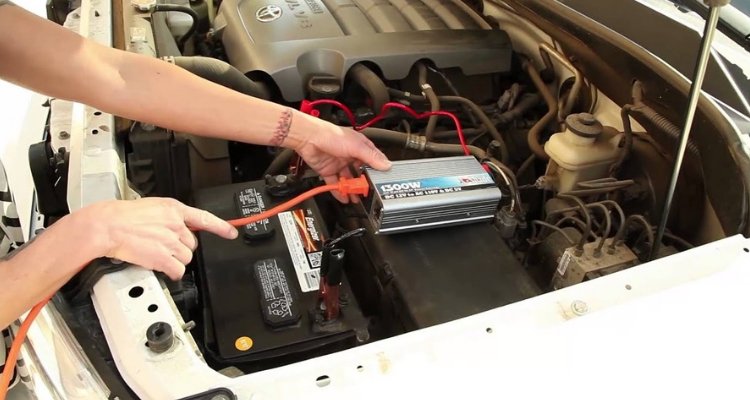
A power inverter for your car can be used to access a small amount of power in an emergency. Yep, I'm talking about those things with wall plugs that you plug into your cigarette lighter. These devices are changing the direct current from your car's system into alternating current, like you would normally use when you plug things into a wall outlet in your house.

So basically, if you want to use a car inverter during an emergency, you would plug it into the cigarette lighter, and then run an extension cord into your home to power the devices that you need.

Essentially, this is like your own mini generator. Although these are not able to deliver as much power, you can get an inverter that will work with your car for a fraction of the cost.

Generators Emergency Power

Generators

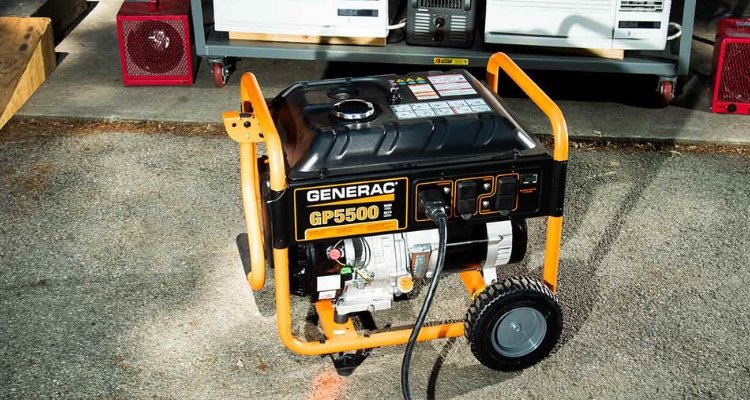
A generator is another solution for creating off grid energy. Generators are small motors that basically turn fuel into electricity. They give you the ability to keep things running during power outages. During Hurricane Katrina, there were some folks powering their houses for several weeks with generators and gasoline they had stored.

Generators can be portable (think about the red Honda generators that you see on construction job sites), or permanently installed in one place (like the Generac whole house units that are attached to a home's foundation).

They can run on a variety of different fuels. Gasoline, diesel, natural gas, or a combination of multiple fuel types. You'll also hear people talk about "solar generators", that really are just large batteries that are made to work with solar panels and store electricity.

Like an off grid solar system, generators need to be sized appropriately for the amount of wattage you need. This is determined by adding up the wattage requirements of the different appliances and systems in your home.

Off Grid Solar Panels

Off Grid Solar Energy

While there is such a thing as a grid-tied solar system, they don't serve preparedness purposes, because they are don't have a means of storing any power, and don't work during power outages or other emergencies.

On the other hand, off grid solar systems are connected to batteries that can store electricity. This means that they can be used in emergencies when nobody else has power.

For your solar setup to work independent of the grid, you essentially need 4 components:

Solar panels - The black panels that sit on your roof or near your home and collect the sun's rays

Batteries - Where the electrical current is stored.

A Charge Controller - Monitoring how full your batteries are, and protecting them from being overcharged

An Inverter - Changes the electricity stored in your batteries from "direct current" to "alternating current", so it can be used to power things in your home.

Residential Wind Turbine

Residential Wind Turbine Generators

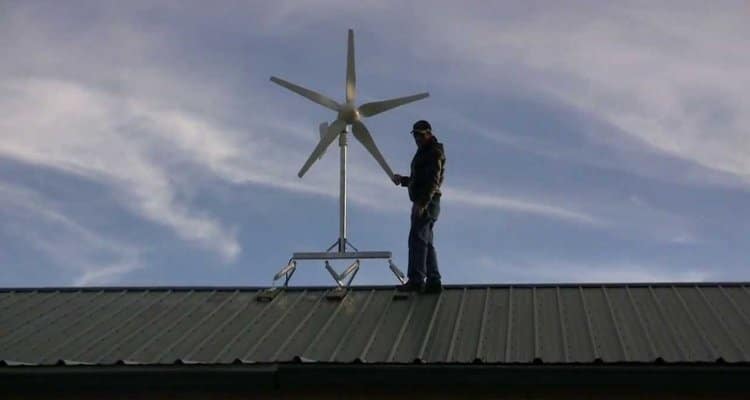
Creating power with a wind energy system involves the same components as an off grid solar system, with one obvious difference. Instead of collecting energy from the sun's rays, you're collecting energy from wind, with a turbine.

Wind energy is considered "greener" than solar energy, although it comes with some marked disadvantages. The biggest one is that the use cases for actually generating meaningful energy from wind turbines are so much more limited. Your home site needs to be in a really specific location in order to be able to harvest enough wind to make it worth it the cost.

Another vulnerability of wind systems is that the actual wind turbine is more fragile and susceptible to damage. If you think about it, the process for collecting solar energy is totally passive (solar panels sit there and soak up the sun's rays), while the process for harvesting wind power is kinetic, and involves a spinning turbine. This alone makes it more likely to wear out or malfunction.

The last thing to think about before you decide to invest in wind power for your home, is that the installation itself is far more complicated for wind than it is solar. Installing a wind turbine involves setting up a tall tower, and getting the angles perfect.

Apart from all of this, prior to setting up a wind generator system, you should really have a wind study done for your site, which takes a full year to do correctly.

When you combine all of these factors, you will find that most home sites around the world are better suited to solar power than wind energy. However, for homes where this isn't the case, wind power is completely viable, and with extremely careful planning can be a solid option.

Micro Hydro Generators

Micro Hydro Systems

Like wind, a micro hydro generator is powered by the spinning of a rotor. The difference obviously, is that a micro hydro system is propelled by water, whereas a windmill is powered by wind.

In the right situations, micro hydro has some powerful, compelling upside. The biggest is that the flow of power can be continuous. The water doesn't "set" every night like the sun does, or come in "gusts" like the wind. It runs all day and all night.

It is so consistent, that some homeowners with micro hydro systems installed on their property don't even have batteries to store electricity. There is enough power constantly flowing from the water, that they don't need to store any (Unless however, your stream is affected by seasonal flows, in which case, you might not have power come the end of the season).

Micro hydro setups can also be installed with relatively little impact to the stream, fish or other wildlife. It takes some know how, but it doesn't have to be complicated.

The biggest downside to micro hydro power is that it is uber site-specific. When compared with the amount of people that have access to wind or the sun's rays, folks that have access to enough running water on their property to make micro hydro a viable energy solution are extremely few.

There are also some states that have regulations about micro hydro systems, falling under the water rights set of legislation. If you are thinking about pursuing it, make sure you're not running afoul of these. History is replete with nasty entanglements over water (especially in the American West!).

How To Safely Store and Handle Propane

March 8, 2024 by Seasoned Citizen Prepper

How To Store Propane

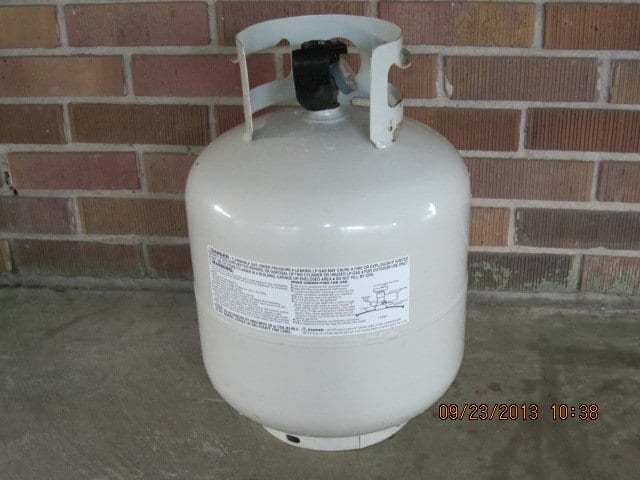
Many of us use 20 pound propane tanks in Barbeque Pits/Grills, space heaters, campers, etc. If you are like me, I have a couple of spare tanks because of hurricane season and other emergencies.

After seeing that massive fire of 20 pound propane tanks on July 30, 2013 at the “Blue Rhino” propane refilling plant in Florida, it got me thinking about how little I knew about the safe handling and storage of these highly flammable and explosive tanks.

So I started to do some research and found out a lot I did not know.

I thought I would share some of what I learned:

If you ever smell any type of gas immediately put out all smoking materials and other open flames such as the pilot lights on cooking stoves, heaters and water heaters.

If you are able to, safely turn off the cylinder valve. To close the valve turn it to the right (clockwise).

Immediately leave the area and call 911 or your local fire department.

Before you use any propane appliance, have a qualified service technician inspect your cylinder and appliance.

Some people may have difficulty smelling propane due to their age (older people may have a less sensitive sense of smell); a medical condition; or the effects of medication, alcohol, tobacco or drugs. Consider purchasing a propane gas detector as an additional measure of security if you use propane inside your camper or home.

Odor fade is an unintentional reduction in the concentration of the odor of propane, making it more difficult to smell. Although rare, this can be caused by the presence of air, water, or rust in the cylinder. New and reconditioned small empty cylinders that sit too long before being filled are prone to internal rust when moisture and air get inside.

NEVER store or place a propane cylinder indoors or in an enclosed area such as a basement, garage, shed, or tent.

NEVER store or place a propane cylinder in an area of excessive heat (120 degrees or higher) or near a stove, fireplace, or other heat source. The heat builds up pressure inside the cylinder, which may cause the pressure relief valve to release propane. Flash fires or explosions can result from exposing cylinders to heat.

NEVER store or place a spare cylinder under or near a barbecue grill.

DO NOT smoke or have any ignition sources such as flames or spark-producing electrical tools in the area while handling or transporting cylinders.

ALWAYS transport and store a cylinder in a secure and upright position so it will not fall, shift, or roll.

I have found a really easy and cheap way to securely store and transport a 20 pound propane tank. A 20 pound propane tank fits inside a plastic milk crate perfectly. Place the 20 pound propane tank inside a milk crate. Take a second milk crate and place it on top of the first milk crate. This makes a 20 pound Propane tank difficult to turn over and nothing can hit the value assembly.  When you are ready to use the cylinder, just remove the top milk crate, make the connection and it is ready to use.

NEVER keep a filled cylinder inside a hot vehicle.

ALWAYS place the cylinder in a well-ventilated area of the vehicle when being transported.

ALWAYS proceed directly to your destination and immediately remove the cylinder from your vehicle.

The law places limits on the number of cylinders and the amount of propane that can be transported in closed-bodied vehicles such as passenger cars and vans. Ask your propane retailer for more information on state and local codes that apply to you.

DO NOT, UNDER ANY CIRCUMSTANCES, TRY TO MODIFY OR REPAIR VALVES, REGULATORS, OR OTHER CYLINDER OR APPLIANCE PARTS. Propane cylinders have special components such as valves, connectors, and other parts to keep them safe for use with grills and other propane appliances. Damage to any component can cause a gas leak. DON’T RISK IT! Call your propane retailer or a qualified service technician for assistance.
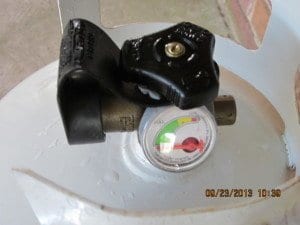
It is important to inspect your cylinder and outdoor gas appliances for leaks. Do this before using them for the first time each season, as well as on a regular basis. This can be accomplished in a well-ventilated area with a simple “bubble” test:

Apply leak detector solution or thick soapy water to the connection(s) between the cylinder valve and the regulator outlet.

Slowly open the cylinder valve and watch for bubbles.

If bubbles appear, close the cylinder valve, tighten the connection, and repeat the process. If bubbles still appear, call your propane retailer immediately.
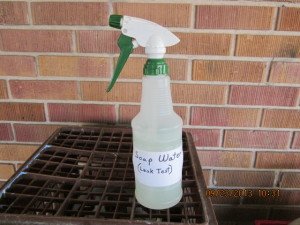
I found that an easy way to do this test is to make a soapy solution out of dish washing liquid and water. I then place the mixture in an empty, clean spray bottle.

When you want to check for a leak, you simply squirt some of the soapy solution onto the area you want to check and watch for any bubble that may form. By using the stream setting instead of the mist setting, you can direct the stream directly on the area you want to check without creating a mess.

MAKE SURE YOUR CYLINDER IS EQUIPPED WITH AN OVERFILL PREVENTION DEVICE (OPD). An OPD is a safety feature that helps prevent small propane cylinders from being overfilled. An overfilled cylinder doesn’t have enough space left if the liquid expands when exposed to warmer temperatures. This can cause an increase in cylinder pressure and create potentially hazardous conditions.

Most cylinders with OPDs have special triangular hand wheels with the letters “OPD” on them. In many states, cylinders without OPDs cannot be refilled. If you are uncertain as to whether your cylinder has an OPD valve on it, ask your propane retailer.

ALWAYS close the cylinder valve and seal with a plug, even if the cylinder is empty. Ask your propane retailer if a plug is required. A plug or cap prevents insects from building their nest inside to threaded portion of the valve assembly. A plug or cap also keeps out the dust and dirt.

NEVER use a damaged cylinder or a cylinder that has been in a fire. All cylinders must be inspected before they are refilled. The law requires periodic inspection of cylinders, and it is against the law to refill out-of-date cylinders. The last inspection date is stamped on the cylinder.

NEVER dispose of your propane cylinder by throwing it in the trash. Check to see if there are municipal programs for collection in your area, or contact your propane retailer for guidance on disposal of the cylinder.

A propane leak has a strong, unpleasant smell, like rotten eggs, a skunk’s spray, or a dead animal. Propane manufacturers add the smell deliberately to help alert customers to propane leaks, which can create a safety hazard. You can ask your propane retailer for a demonstration to help everyone in your home or building, identify leaks.

Filed Under: Alternative Energy

  • « Go to Previous Page
  • Page 1
  • Page 2

Copyright © 2026 · Genesis Sample on Genesis Framework · WordPress · Log in

  • Privacy Policy