
If you have a small garden plot and don’t like digging it up every year, Three Sisters gardening may be for you. It’s a Native American companion planting technique at least 1,000 years old — practiced by the Haudenosaunee (Iroquois) Confederacy, the Pueblo peoples of the Southwest, and Mesoamerican milpa farmers across what is now Mexico and Central America. They grew these three crops together not for tradition’s sake but because it works: the combination produces genuinely higher yields than any of the three plants grown alone.
It adapts to climate conditions, requires minimal year-to-year soil disturbance, and produces calorie-dense crops you can store. For a survival garden or homestead, it’s one of the most efficient things you can plant.
So, What Are The 3 Sisters?
The Three Sisters are corn, beans, and vined squash. Each one solves a specific problem for the others:
- Corn grows tall and straight, providing a natural trellis for the beans to climb — no stakes or cages needed. It’s a heavy feeder and susceptible to wind, both of which the beans help address.
- Pole beans fix nitrogen from the air into the soil through bacterial activity in their root nodules, feeding the corn and squash. Their flowers attract pollinating insects. Their vines bind the corn stalks together for wind resistance.
- Squash spreads across the ground as a living mulch — shading out weeds, retaining soil moisture, and deterring deer and raccoons from the corn with its prickly leaves and vines.
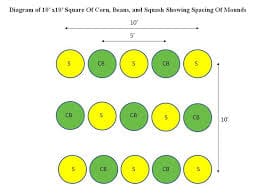
Check out the layout depicting the placement of corn, beans, and squash.
Mound, Flat, or Depression — Match Your Climate
In wet or cold climates, mound your planting area. Corn hills about 5 inches high and 18 inches across allow the soil to warm more quickly in spring and improve drainage. You can plant earlier this way, which matters in a short growing season. In dry climates, dig a slight depression instead — it channels water toward the roots and retains moisture that would otherwise evaporate. If you’re getting the normal 40 inches of rain most vegetables want, a flat circle works fine.
Choosing Your Varieties
Variety selection matters more than most Three Sisters guides admit. The wrong choices and the system doesn’t work — the corn gets overwhelmed by the beans, or the squash clumps rather than spreads.
Corn: Three Sisters gardening often works best with flint, dent, or flour corn varieties, as they are harvested at the end of the season. Native American varieties like Hickory Cane Dent Corn and Cherokee White Flour work well. Sweet corn can be used but requires you to carefully navigate sprawling squash vines at harvest. Avoid very tall, weak-stalked hybrid varieties that may fall over once beans start climbing.
Beans: They must be pole beans (vine-type), as modern bush beans are incapable of climbing cornstalks. Good pole bean choices include Blue Lake, Scarlet Runner, and Italian Snap. Kentucky Wonder — which we grow and review here — is one of the most reliable heirloom options for this system.
Squash: Use a winter squash variety — butternut, acorn, delicata, and the like — which grow on vines that spread across the ground. Summer squash varieties like crookneck and pattypan won’t work because they grow in single clumps rather than as a spreading groundcover. The trailing vines are what make the living-mulch system function.
Corn — Planting and Growing
Corn is wind-pollinated and needs other corn in close proximity for best results — no pollination means no kernels. This is why you never plant corn in a single row, and why the circular or clustered mound system works so well: plant corn first after the last frost, when soil temperatures reach at least 55°F. Plant 4 corn seeds in a square pattern at the center of each mound, then thin to the strongest 3 seedlings after germination. By planting in a tight cluster you get optimum cross-pollination between plants.
Pole Beans — Structure and Nitrogen
If you’ve ever planted pole beans you know they will take over any structure they can find. That’s the feature, not the bug. When corn reaches 4 to 6 inches tall, plant 4 pole bean seeds around each corn stalk — one bean at each of the 4 compass points, 6 inches from the corn. The vines will bind the corn stalks together, providing maximum wind resistance. The flowers attract pollinators that benefit the whole garden.
One thing worth doing: coat the bean seeds with an inoculant before planting for better nitrogen fixation. Inoculant is a powder containing the right bacteria for legume nitrogen fixation — inexpensive, widely available, and makes a real difference in soil enrichment, especially in new garden beds.
Squash — Moisture, Mulch, and Deterrence
When the beans reach six inches, plant squash seeds around the perimeter of the mound, spacing them 18 inches apart. The spreading leaves retain moisture in the ground, stunt weed growth by shading the area, and attract additional pollinating insects. The prickly texture of squash leaves and vines also deters deer and raccoons — they don’t like navigating through it to reach the corn.
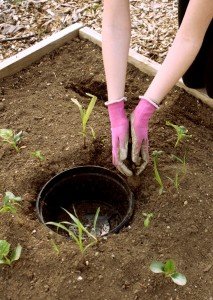
Here’s a setup that works well: sink a garden pot in the center of your mound for deep watering. Plant six corn around that pot. Add the beans on the outside of the corn a week later, and four squash plants a week after that. The sunken pot directs water straight to the root zone — efficient, especially in dry stretches.
Getting Going — Planting Schedule
The staggered timing is critical. Plant everything at once and the corn gets overwhelmed before it can establish:
- Corn first — after last frost, soil at 55°F minimum
- Beans about a week later — once corn is 4–6 inches tall and growing confidently
- Squash a week after that — when beans are reaching 6 inches
Want to extend your harvest across the season? Sow seeds any time after spring night temperatures are in the 50-degree range, up through June. Plant successive mounds a week or two apart and you’ll have Three Sisters dining for as long as your growing season holds. Depending on how you like to put up vegetables, you can spread the work across the summer or batch it all at the end into a big canning session.
One more maintenance note: do not apply nitrogen fertilizer once beans are established — the bacterial fixation in the bean roots supplies what the corn needs. Adding nitrogen at that point throws the system off balance.
Storing Your Harvest
Squash stores particularly well. A dry, cool area — root cellar, basement shelf, spare bedroom — keeps most winter squash in good eating condition for three to six months without any processing. Butternut and acorn are the most forgiving. Check them monthly and use any that start to soften first.
Dried beans from this system are among the most storage-friendly calories you can grow yourself — sealed in Mylar with oxygen absorbers, they last 20+ years. Corn can be dried and ground into meal, or pressure-canned as whole kernel. The Three Sisters aren’t just a companion planting system — they’re a complete calorie-crop strategy. For more on maximizing what your garden produces for long-term storage, see our calorie crops and gardening for survival guides.
Don’t overthink this one. Just have fun and enjoy some sweet, all-American calorie crops.