
Short answer: If you want the best value and quality food storage for a family of 4 and want to be done with it, the Augason Farms 1-Year Food Storage for 4 People is our top pick. It has the most transparent calorie labeling in the industry and the lowest cost per 2,000 calories of any major commercial option. Search for it on Amazon or the Augason Farms website for current pricing.

Commercially manufactured survival food is a legitimate option — shelf-stable for years or decades, requires no prep beyond a bucket and a closet, and removes a lot of the friction from getting started. The honest caveat: pre-packaged emergency food is more expensive per calorie than bulk staples. Some of that premium pays for quality freeze-drying and real shelf life. Some of it pays for marketing.
The smartest way to cut through the fog is to compare on a single objective metric: cost per 2,000 calories. Every company uses different language — “servings,” “pouches,” “entrees,” “meals,” “days.” None of those mean anything without knowing the actual calorie count behind the label. Calories are honest. Everything else is marketing.
Cut through the marketing: compare by calories
Before comparing companies, take a look at the actual total calorie count on whatever you’re buying — not the serving count. A “60-serving” bucket from one company might deliver 1,800 calories per day for one person. The same description from another company might deliver 900. The only number that tells you how much food you’re actually buying is total calories.
We also recommend calculating “cost per 2,000 calories” — because some packages are larger than others, and buying two smaller packages sometimes beats one large one on value. Here’s the comparison table across the major 1-year supply options. Note: prices below were gathered at time of original research — verify current pricing before purchasing, as survival food costs fluctuate. The calorie figures and cost-per-calorie rankings are the more durable reference point.
| Company | Price (verify current) | Total Calories | Cost Per 2,000 Cal |
|---|---|---|---|
| Augason Farms | ~$3,500 | 1,932,950 | $3.62 ✅ Best value |
| Saratoga Farms | ~$2,713 | 735,243 | $7.38 |
| E Foods Direct | ~$2,887 | 720,480 | $8.01 |
| Mountain House | ~$5,000 | 724,890 | $13.80 |
| Valley Food Storage | ~$2,209 | 299,665 | $14.74 |
| Daily Bread | ~$6,103 | 720,672 | $16.94 |
| Emergency Essentials | ~$6,000 | 679,530 | $17.66 |
| Survival Cave Food | ~$6,818 | 1,387,920 | $9.82 |
| Legacy | ~$8,790 | 1,698,720 | $10.35 |
| My Food Storage | ~$8,164 | 1,590,620 | $10.27 |
| Lindon Farms | ~$3,899 | 730,000 | $10.68 |
| Backpacker’s Pantry | ~$47,080 | 2,467,860 | $38.15 |
Two things this table makes clear immediately: Augason Farms is in a different value category than everyone else at $3.62 per 2,000 calories. And Backpacker’s Pantry, while excellent freeze-dried food for actual backpacking, is not a cost-rational choice for emergency food storage at $38.15 per 2,000 calories.
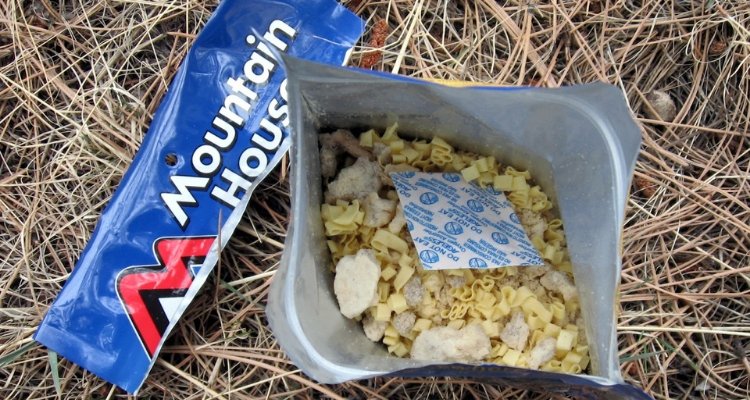
1. Mountain House
Mountain House is the pioneer — started in 1969, originally making freeze-dried food for outdoor enthusiasts who needed real nutrition in the backcountry. They have the longest track record and consistently the best reviews on taste. People are genuinely surprised that freeze-dried food can taste this good; Mountain House has built its reputation almost entirely on that one differentiator.
Over time Mountain House expanded into prepper and emergency lines, offered in 2-day through 14-day supplies and larger emergency kits. The kits are more portable than buckets, which makes them attractive as a bug-out food option rather than just a stay-in-place storage solution.
The honest tradeoff: Mountain House is not the value play. At ~$13.80 per 2,000 calories for a 1-year kit, you’re paying a significant premium for that taste quality and brand trust. If taste during an emergency matters a lot to your household — and for morale, it genuinely does — Mountain House is worth the cost. If you’re optimizing purely for calories per dollar, it isn’t. For a deeper look at the individual meals see our Mountain House meals review.
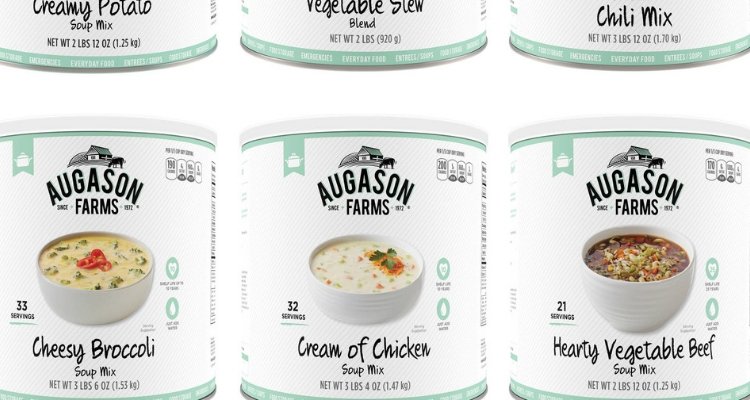
2. Augason Farms
Augason Farms is our overall recommendation, and the calorie table explains why. At $3.62 per 2,000 calories they offer roughly twice the calorie value of most competitors at comparable price points. Their best-known products are #10 cans of individual freeze-dried and dehydrated ingredients — scrambled eggs, apples, bananas, potato slices — plus complete entree meals and month-long bucket options.
The packaging philosophy is notable: larger serving sizes rather than single-serve pouches. A 7-serving bag of macaroni, for example. This is better suited to home kitchen use than backcountry cooking, which is how most emergency food gets eaten anyway. It also makes Augason a better fit for family use than for solo hiking.
Taste reviews are solid but not glowing — people generally say it’s good and they’re happy with it, without the enthusiasm Mountain House gets. The transparency on total calories is genuinely appreciated and unusual in this industry. Most companies make you do math; Augason tells you exactly what you’re buying. That alone makes comparison shopping easier.
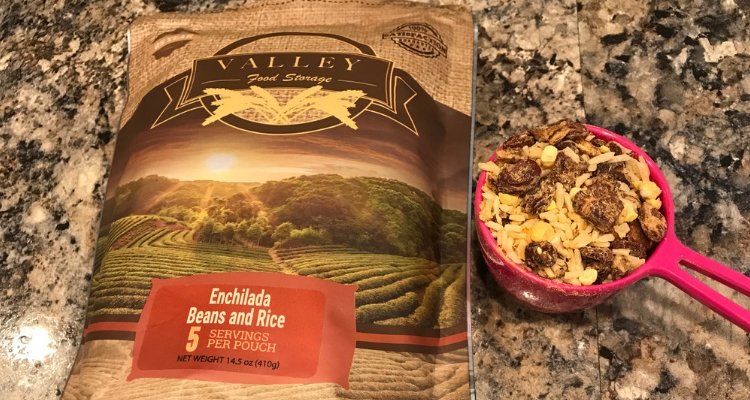
3. Valley Food Storage
Valley Food Storage’s differentiator is ingredients: no MSG, no artificial preservatives, no cheap filler ingredients. They’re the “clean label” option in a category that doesn’t always prioritize that. If your household reads ingredient labels on everyday food, you’ll appreciate that Valley Food Storage extends that standard to emergency food as well.
They offer 1, 3, 6, and 12-month storage options plus shorter-term kits. Satisfaction guarantee and generally strong customer service reputation. The honest numbers: at $14.74 per 2,000 calories, clean ingredients cost more. Whether that tradeoff makes sense is a household decision — the food quality and ingredient standards are real, but you’re paying nearly four times Augason’s per-calorie rate for them. Good first choice for households with specific dietary concerns or strong preferences about food quality; less competitive for pure calorie-storage value.
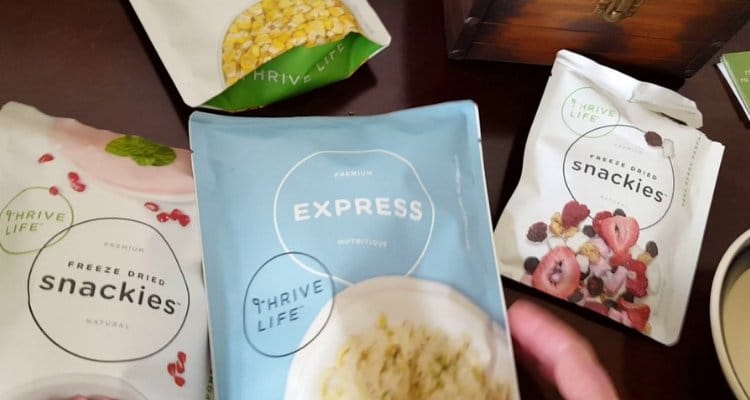
4. Thrive Life
Thrive Life — originally called Shelf Reliance, a company that made rotating food storage shelving systems before moving into food — is best known for its #10 cans of individual freeze-dried ingredients. Fruits, vegetables, grains, meats, sauces: the range is genuinely broad. If you want to build a custom food storage program from individual ingredients rather than pre-assembled meal buckets, Thrive gives you more granular options than most.
One thing worth knowing: Thrive operates partly through a network marketing model. You can buy directly online, but you can also sign up as a distributor if that’s your thing. For most people this is irrelevant — the food stands on its own merits. The MLM structure just means you may encounter Thrive through a distributor contact rather than a store, which can affect pricing depending on how you buy.

5. Legacy Emergency Food
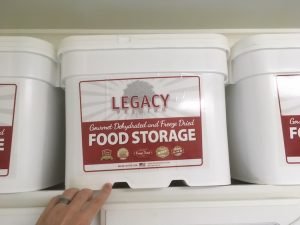
Legacy markets itself on lowest cost per pound, though by our cost-per-2,000-calorie metric they come in at $10.35 — better than Mountain House and Valley Food but behind Augason and ReadyWise. Where Legacy genuinely stands out is portion sizes: reviewers consistently mention that Legacy portions are larger than most competitors, which matters for actual satiety and for how many days a supply realistically lasts.
The buckets feature molded plastic grooves on the bottom for stable stacking — a practical design detail if you’re storing multiples. Legacy maintains a 4.4/5 rating on Amazon across a large review base. As a well-reviewed, mid-priced option with better-than-average portion sizes, Legacy is a solid pick especially for families prioritizing fullness per meal over the lowest per-calorie cost.
A Note on ReadyWise (formerly Wise Food Storage)
You will likely encounter ReadyWise in your research — it is widely sold and heavily marketed, so it deserves a direct explanation of why we do not recommend it.
Wise Food Storage (now rebranded as ReadyWise) was the subject of a federal class action lawsuit filed in 2017: Miller v. Wise Company Inc., U.S. District Court, Central District of California, Case No. 5:17-cv-00616-JAK-PLA. The lawsuit alleged that the company deceptively marketed its long-term food kits as sufficient to sustain a specific number of people for a specific period of time — when in reality, the kits did not provide adequate calories to do so. Plaintiffs argued the calorie shortfall was severe enough that someone relying solely on these kits in a genuine emergency could face adverse health effects and starvation.
Wise settled the lawsuit. As part of the settlement, the company paid class members between $15 and $1,400 per product, and — critically — agreed to stop claiming its kits would sustain a person for a specific number of days unless the kits actually provided at least 2,000 calories per day. That the settlement required this change confirms the core allegation: their marketing overstated what the food would actually do for you in a survival situation.
The company subsequently rebranded to ReadyWise and has made changes to its packaging and marketing. Independent reviewers have noted improved calorie counts post-settlement. But the underlying company is the same, and the nature of what they were sued for — misrepresenting how long their food would sustain you in an emergency — is the exact failure that matters most in this category. We do not feel comfortable recommending a company with that track record to readers who may one day depend on what they store.
If you already own ReadyWise products, check the actual calorie count on the label against your household’s daily needs — 2,000 calories per person per day is the standard planning benchmark — and verify the kit covers what you think it covers. Do not take the serving count or day count on the label at face value without doing that math yourself.
Free Emergency Food Samples: Try Before You Commit
If you’re on the fence about which company to go with, several will send out a free sample — usually you just cover shipping. This matters more than it sounds: buying several months of food storage only to learn your family won’t eat it is an expensive mistake. Try a meal or two first.
Your best bet is going directly to the company’s website rather than Amazon — free samples are usually not listed on third-party marketplaces. Look for a “free sample” link in the website menu or on the homepage. Here are companies that have offered free samples — verify each is still active before ordering, as these programs change:
- Augason Farms free sample
- Valley Food Storage free sample
- Daily Bread free sample
- Survival Cave Food — check homepage for current sample offer
- Harvest Right free sample
Once you’ve tried a few, the best price on most of these companies’ products is usually found on Amazon or direct from the company website during a sale. Check both before buying in bulk.
Survival Food Storage FAQ
How much does a year’s worth of food cost?
Using Augason Farms as the benchmark (best calorie value in the table), a year’s supply for a family of four running 2,000 calories per person per day costs roughly $5,000–$5,500 at current pricing. That number shifts based on whether you have young children vs. four adults, how much of the supply is commercial vs. bulk staples, and what’s on sale when you buy. A more detailed breakdown of what a real year supply actually requires — including the calorie math most commercial marketing skips — is in our survival food list guide.
How much rice do I need for a year’s supply?
Rice is one of the best staples to store — cheap, with a 25–30 year shelf life when properly sealed in Mylar with oxygen absorbers. Store at least 300 pounds of grains per person per year, of which 25–60 pounds should be rice. That gives you a solid calorie base to build around. Store white, Basmati, or Jasmine rice — brown rice’s oils go rancid within a year or two, making it a poor long-term storage choice.
How much does freeze-dried food cost per serving?
Because of the processing involved, freeze-dried food carries a premium. The range in our table runs from $3.62 to $38.15 per 2,000 calories — a tenfold spread. Most of the reputable mid-tier companies land between $8 and $14 per 2,000 calories. Anything significantly above $15 per 2,000 calories is a specialty product (clean-label, gourmet, backpacking-focused) where you’re paying for something beyond basic calorie storage.
How do you store food for a disaster?
Commercial emergency food comes pre-packaged for long-term storage — most companies claim 25-year shelf life under proper conditions. The keys are cool temperatures (below 70°F, cooler is better), dark storage, low humidity, and airtight containers. For bulk staples you pack yourself (rice, beans, wheat), sealed #10 cans or 5-gallon buckets lined with Mylar bags and oxygen absorbers are the standard — the same method we cover in detail in the survival food list. Heat is the enemy: every 10°F drop in storage temperature roughly doubles your effective shelf life.
Is commercial survival food worth the cost vs. packing your own?
Depends on what you’re optimizing for. Packing your own bulk staples (rice, beans, oats, wheat, oil) gives you the lowest cost per calorie by a significant margin — our food storage guide shows how to do this for roughly $900–$1,500 for a family of four for a year. Commercial survival food costs 3–10x more per calorie but saves you the packing work, gives you meal variety right out of the bucket, and stores in a more organized, portable format. The smart approach for most families is a mix: bulk staples as the calorie base, commercial freeze-dried meals for variety, morale, and easy grab-and-go options.